
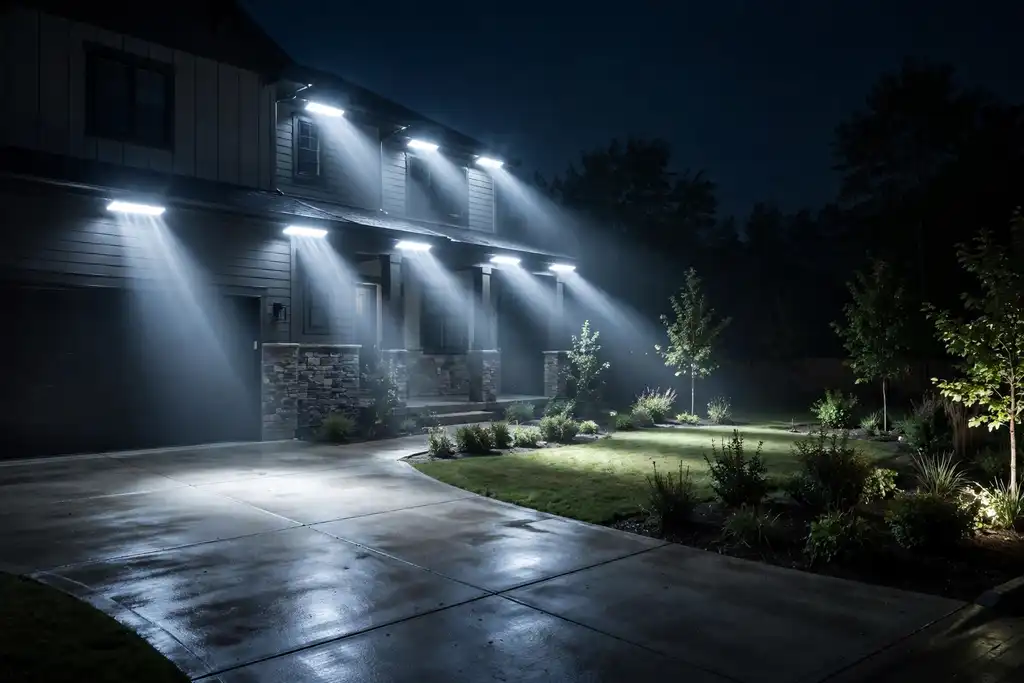
People often buy outdoor LED flood lights on wattage alone and end up with glare that annoys the neighbours. Beam angle and mounting height matter just as much as brightness.
You want a light that covers a driveway, yard or facade without harsh spill. The wrong beam pattern can leave dark corners or blind anyone nearby. Our research points to the best outdoor led flood lights for a clean, even spread.
We narrowed a long list to a short set, and every pick had to pass one rule: honest light output for the space it serves. We compared beam angles, colour temperature, build sealing against rain, and owner feedback on glare and reliability to find the best led flood lights.
Top 3 Picks for Best Outdoor Led Flood Lights

MELPO LED Flood Light
- ▸App and Bluetooth control
- ▸16 million colors
- ▸IP66 waterproof rating

YANYCN 100W LED Flood
- ▸11600lm at 5000K
- ▸IP66 waterproof housing
- ▸180-degree adjustable bracket

Onforu 75W Flood Lights
- ▸Three adjustable heads
- ▸7000lm brightness
- ▸Switch controlled only
10 Best Outdoor Led Flood Lights
Our Top Outdoor Led Flood Lights Reviewed
1. MELPO LED Flood Light – App-Controlled Color Changing
App-Controlled Color Changing
PROS
- ✓Bluetooth mesh control across many lights
- ✓16 million colors and 12 dynamic modes
- ✓Daily timing schedules built in
- ✓IP66 rating for rain and dust
- ✓Four pack covers a whole yard
CONS
- ✗Color features depend on the app
- ✗Not a simple switch-only fixture
MELPO LED Flood Light Outdoor 800W Equivalent…
- 80W, 8000LM, 2700K warm white
- Bluetooth 5.0 with mesh function
- Timing chip for daily schedules
- DIY scenes and group control
- IP66 waterproof, US plug
The MELPO LED Flood Light is the one we point to when someone wants color and mood control outside, not just raw brightness. Each unit runs at 80W and puts out 8000 lumens in warm white at 2700K, with a CRI above 85. The real draw is the app control over Bluetooth 5.0, which opens up 16 million colors, 12 dynamic modes, strobe, timing and DIY scenes. For a patio, garden or festival setup, that flexibility is hard to match.
We looked closely at how the controls work in practice. The mesh function lets the lights forward signals to each other, so you can control any number of units from one phone without the range problems that plague some remote and Wi-Fi setups. You can set a color or mode for the yard and have it switch on at 6:30pm and off at 1:00am every day, which suits people who want their lighting to run on a routine without touching a switch.
The four pack format matters for outdoor work. You can assign a different color or mode to each lamp and save the combination as a scene for parties, BBQs, garage lighting, tree uplighting or holiday displays. The IP66 rating covers rain and dust, and the US plug means no extra wiring for a standard outlet. Each unit measures 9.44 inches long, 6 inches high and 2 inches wide, so they mount on walls and posts without much bulk.
The efficiency class is listed at 100 lumens per watt, which is respectable for a color-changing fixture, and the two year warranty gives some cover for outdoor use. Owners commonly report that the app pairing is quick and that the schedule holds. The main trade-off is that this is a smart fixture first and a security light second, so if you want simple switched brightness, the app dependency may feel like extra steps.
Best for Color and Scene Lighting
This suits homeowners who want their outdoor lighting to do more than illuminate. If you host BBQs, decorate for holidays or want uplighting on trees and walls, the color range and saved scenes make setup easy to repeat.
It also fits anyone with several fixtures to manage. The mesh function and group control mean one phone can run the whole set, and the timing chip keeps the yard lit on schedule without daily input.
Not Ideal for Simple Security
Skip this if you want a plain floodlight you flip on at the wall. The MELPO is built around app control, so the extra features add steps for basic use.
It is also a poor fit for anyone who wants motion detection or dusk to dawn automation. The data lists app, timing and scene control, not sensors, so a security-first buyer should look elsewhere.
2. YANYCN 100W LED Flood – High Output Daylight White
High Output Daylight White
PROS
- ✓Very high 11600lm output
- ✓IP66 rating with tempered glass
- ✓Adjustable 180-degree bracket
- ✓Wide 85V to 277V AC input
- ✓Four pack for large areas
CONS
- ✗Daylight white only, no color options
- ✗Bright output can overwhelm small spaces
YANYCN 4 Pack 100W LED Flood Light,Super…
- 100W, 11600lm, 5000K daylight
- 120-degree beam angle
- IP66 waterproof, tempered glass
- 85V to 277V AC voltage
- 50,000 hour LED lifespan
The YANYCN 100W LED Flood is the brightest option in this group on paper, and that is the reason we ranked it here. Each unit produces 11600 lumens of 5000K daylight white through a 120 degree beam, which the listing compares to a 700W halogen. For a yard, garden, basketball court or arena, that output means you can light a large area from fewer fixtures. The four pack covers a big property without stretching the budget.
We paid attention to the build because outdoor fixtures live or die on heat and water. The LED chips sit in an aluminum housing with upgrade heat sink fins on the back that increase air contact area, and the rated chip lifespan is 50,000 hours. The IP66 rating plus tempered glass over the LEDs means rain, snow and water spray should not get inside. That combination is what we want to see for year round exterior use.
Mounting is more flexible than many plugs-in floods. The widened and thickened metal bracket adjusts through 180 degrees, so the light can be ceiling mounted, wall mounted or angled down a driveway. It runs on 85V to 277V AC, which makes it usable on a range of supplies, and the plug means a standard outlet works. Each unit is 10 inches high, 8 inches long and 4 inches wide, so plan for a bit of clearance behind the fins.
Owners commonly report strong brightness and a solid feel from the aluminum body. The daylight white color is neutral and good for visibility rather than atmosphere, which suits security and sports areas. The two year warranty is listed. The honest downside is that 11600 lumens is a lot of light for a small patio, so this is a fixture to aim at open ground, not a cozy seating corner.
Best for Large Open Areas
This is for people lighting big outdoor spaces where coverage matters more than mood. Yards, gardens, courts and arenas all benefit from the 11600lm output and the 120 degree spread.
It also suits installs that need flexible aiming. The 180 degree bracket and wide voltage range let you mount it on walls, ceilings or posts and point it where the light is needed.
Not Ideal for Decorative Use
Skip it if you want warm or colored light for a patio or garden feature. The YANYCN is fixed at 5000K daylight white, so it reads as functional rather than atmospheric.
It is also overkill for small spaces. On a tight balcony or narrow path, 11600 lumens per fixture will be harsh, and you would be paying for output you cannot use comfortably.
3. Onforu 75W Flood Lights – Three-Head Wide Coverage
Three-Head Wide Coverage
PROS
- ✓Three heads adjust through 270 degrees
- ✓7000lm from 112 LED beads
- ✓IP65 rated for rain and snow
- ✓Simple wall switch operation
- ✓Aluminum housing with fin heat sink
CONS
- ✗No motion sensor or dusk to dawn
- ✗Fixed 6500K color only
Onforu 2 Pack 75W Flood Lights Outdoor…
- 75W, 7000lm, 6500K
- 112 LED beads
- 3 heads, 270 degree adjustable
- IP65 waterproof rating
- Aluminum housing, fin heat sink
The Onforu 75W Flood Lights take a different approach to coverage. Instead of one wide beam, each fixture carries three light heads that adjust through 270 degrees, so you can spread the output across a yard, driveway or garage front. The 75W unit uses 112 LED beads to reach 7000 lumens at 6500K, which the listing compares to a 400W traditional bulb. Two fixtures come in the pack.
We like the switch control for certain jobs. This light turns on and off only from a wall switch, with no motion sensor, no solar and no dusk to dawn. That sounds basic, but it is exactly what some buyers want for a garage, workshop or storage area where they control the light manually. There is no app to pair and no sensor to misread, which keeps the install simple.
Heat and weather protection are handled with an aluminum body and a fin type heat sink design for dissipation. The IP65 rating means it is sealed against dust and protected from rain, sleet and snow, which covers most exterior mounting spots. Each unit measures 10 inches long, 5 inches wide and 4 inches high and weighs 2 pounds, so the bracket needs a solid fixing point on a wall or eave.
Owners commonly report that the three heads make it easy to cover an awkward shape, like the corner of a garage or a driveway that bends. The 85 percent energy saving claim against traditional bulbs is the kind of figure we treat as a guide rather than a promise. The honest limitations are the fixed 6500K color and the lack of any automatic control, so this is a manual, functional fixture rather than a smart one.
Best for Manual Wide Coverage
This suits garages, workshops, storage rooms and driveways where someone is there to flip a switch. The three heads let you aim light into corners and along walls that a single beam would miss.
It also fits buyers who want nothing smart outdoors. No app, no sensor and no schedule means fewer things to set up or fail, and the IP65 housing handles typical rain and snow.
Not Ideal for Automation
Skip it if you want the light to come on by itself. There is no motion sensor and no dusk to dawn function, so an empty yard stays dark until someone uses the switch.
It is also a weak fit for anyone wanting warm or colored light. The 6500K output is cool and functional, which is fine for security but not for a relaxing patio setting.
4. Onforu 75W Flood Brightness – Wide 270 Degree Coverage
Wide 270 Degree Coverage

PROS
- ✓Strong 7000 lumen output for 75W
- ✓Three heads cover a wide area
- ✓IP65 weather rating
- ✓Aluminum housing aids cooling
- ✓Simple switch operation
CONS
- ✗No motion sensor or dusk to dawn
- ✗Requires hard wired junction box install
Onforu 75W Flood Lights Outdoor, 7000LM Brightness…
- 75W output equals 400W traditional bulbs
- Switch controlled, no motion sensor
- 270 degree adjustable illumination angle
- Die cast aluminum heat dissipation
- Mounts to junction box with simple wiring
The Onforu 75W Flood Brightness is the middle child of this group, and it makes sense for a lot of yards. With 112 LEDs pushing out up to 7000 lumens, it is a serious step up from a porch bulb but still draws only 75W. Onforu says that replaces a 400W traditional bulb and saves more than 85% on electricity. For anyone lighting a driveway or side yard where a switch is already handy, that math is appealing.
The three heads are the part we kept coming back to in our research. Each one adjusts independently, and the combined spread reaches up to 270 degrees, which is wider than a single fixed head can cover. That matters outside because you rarely need light in one neat rectangle. You want the door, the path and the corner of the garage all covered without adding a second fixture.
Control is simple by design. This is a switch controlled light, with no motion sensor, no solar panel and no dusk to dawn photocell. We think that suits people who want light on demand and nothing turning on at random. The catch is that you have to remember to flip the switch, and there is no automatic behavior if you are away.
Build quality looks sensible for the price point. The housing is die cast aluminum, which Onforu says dissipates heat better than other brands, and the IP65 rating means it should handle rain, sleet and snow. Installation is hard wired to a junction box with straightforward wiring. At 1.92 pounds and roughly 10.7 inches long, it is manageable for one person on a ladder.
Best for Wide Yard Coverage
This one suits homeowners who want to light a broad outdoor area from a single fixture. The three adjustable heads let you aim light at a door, a path and a parking spot at the same time, and 7000 lumens is plenty for a typical driveway or backyard.
It also works well if you prefer manual control. Because it runs off a wall switch, there is no sensor to false trigger or setting to fiddle with. Flip it on when you need it and off when you do not.
Not Ideal for Hands Off Security
Skip this if you want automatic lighting. There is no motion sensor, no photocell and no solar option, so the light only comes on when someone hits the switch. That is a poor fit for a dark entryway you want lit the moment someone approaches.
Renters or anyone without an existing junction box should also think twice. This is a hard wired fixture, and the box itself is not included, so the install is more involved than screwing in a bulb.
5. Gonhom Par38 Led Flood – Standard Socket Fit
Standard Socket Fit
PROS
- ✓Fits standard E26 sockets
- ✓Dimmable where the fixture allows
- ✓Two bulbs included
- ✓Neutral 5000K daylight color
- ✓Long 25,000 hour rating
CONS
- ✗Needs an existing E26 fixture
- ✗Less bright than wall mounted units
Gonhom Par38 led Flood Lights Outdoor Light…
- 20W replaces up to 200W
- 180 degree beam angle
- Illuminates areas up to 70 feet
- 25,000 hour rated lifespan
- Standard E26 medium screw base
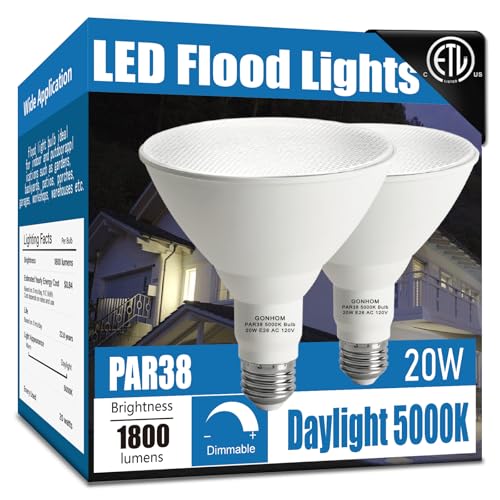
The Gonhom Par38 led Flood is a different kind of product from the wall mounted fixtures here. It is a bulb, not a housing, and it screws into a standard E26 socket. That makes it the easiest option to fit if you already have an outdoor flood holder on the porch, garage or garden wall. Two bulbs come in the pack, so you can replace a pair or keep a spare.
Output is 1800 lumens from just 20W, which Gonhom compares to a 200W bulb and claims saves up to 85% on electricity. The 5000K daylight color is neutral rather than harsh blue, and the 180 degree beam angle is rated to illuminate an area up to 70 feet. For lighting the outside of a house, that is a realistic spread rather than a spotlight punch.
The dimmable rating is worth noting. Many outdoor fixtures are not on dimmers, but if yours is, this bulb will respond. The cooling system uses plastic and aluminum, and Gonhom rates the service life at up to 25,000 hours. The bulb also contains no mercury and releases no hazardous gases, which is a small plus for anyone replacing older lamps.
At 0.55 pounds and about 4.7 inches across, it is a normal Par38 size and should fit most standard holders. The main thing to check before buying is that your fixture takes an E26 medium base and can handle the bulb’s dimensions. If it does, installation is a screw in job with no wiring at all.
Best for Existing Porch Fixtures
This is the pick for anyone who already has an outdoor Par38 holder and wants a brighter, cheaper to run bulb. There is no wiring, no junction box and no mounting hardware, just a screw in swap. The two pack makes it easy to refresh a matching pair.
It also suits people who want dimming. If your porch or garage fixture is on a dimmer, the Gonhom bulb will follow it, which most flood housings cannot do.
Not Ideal for Bare Walls
Skip it if you have nothing to screw it into. This is a bulb only, so a bare wall or eave needs a separate fixture before it will work. If you are starting from scratch, a wall mounted unit is the simpler route.
It is also not the choice for maximum brightness. At 1800 lumens it lights a doorway or small yard well, but it will not flood a large driveway the way the higher output fixtures in this guide can.
6. Onforu 150W LED Security – Maximum 15000 Lumen Output
Maximum 15000 Lumen Output

PROS
- ✓Very high 15000 lumen output
- ✓Three heads for wide coverage
- ✓Matte lens reduces glare
- ✓IP65 weather protection
- ✓Aluminum housing for cooling
CONS
- ✗No automatic sensor control
- ✗Junction box not included
Onforu 150W LED Security Light, 15000LM Outdoor…
- 150W replaces 400W bulbs
- 270 degree lighting angle
- IP65 waterproof rating
- Die cast aluminum housing
- Switch controlled, no sensors
The Onforu 150W LED Security is the heavyweight of this group. It packs 154 LEDs and pushes up to 15000 lumens, which Onforu compares to a 400W high consumption bulb while claiming more than 85% savings on electricity. If you have a large yard, a long driveway or a commercial entryway, this is the output level that actually covers it. For a small porch it would be overkill.
Like its smaller sibling, it uses three adjustable heads that combine for up to 270 degrees of coverage. We like that layout outside because you can aim one head at the gate, one at the door and one across the parking area. The lens is a professional matte design, which Onforu says gives softer light and reduces glare compared with other lights. That is a real consideration on a bright fixture, since harsh glare can be uncomfortable at night.
The housing is die cast aluminum for heat dissipation, and the IP65 rating means it is built for rain, sleet and snow. Onforu lists it for doorways, garages, backyards, porches, entryways, stairs, shops and yards. At 2.6 pounds and 17 inches tall, it is a bigger fixture than the 75W model, so plan for a sturdy mounting point.
Control is switch based only. There is no motion sensor, no solar and no dusk to dawn, so the light does exactly what the switch tells it. Installation is a few wiring steps to a wall junction box, which is not included. We would treat this as a job for someone comfortable with basic electrical work or a hired electrician.
Best for Large Properties
This suits big outdoor spaces that need serious light. A long driveway, a rural yard or a shop front will benefit from 15000 lumens in a way a small porch never could. The three heads let you spread that output across several zones.
It is also a good fit for anyone replacing an old high wattage flood light. The 150W draw against a claimed 400W equivalent keeps running costs down while keeping the brightness up.
Not Ideal for Small Spaces
Skip it for compact areas. On a small porch or a narrow side path, 15000 lumens will be far more light than you need, and the glare can be uncomfortable for neighbors. The 75W model is a better match there.
It is also not for anyone wanting automatic operation. With no motion sensor or photocell, the light depends entirely on the switch. And because the junction box is not included, budget for that part and possibly an electrician.
How to Choose the Best Outdoor Led Flood Lights
Lens and Light Source Technology
The light source inside an outdoor LED flood light matters more than the wattage number on the box. Most models in our research use SMD LEDs, which are small chips spread across a board and give even, broad light. Some fixtures use COB chips, where many diodes sit under one lens for a tighter, more intense beam. For a driveway or yard, SMD is usually the friendlier choice because it spreads light without harsh hot spots.
Lens material is the other half of the story. Polycarbonate lenses resist impact and are common on household fixtures, while glass lenses hold up better to scratching and long sun exposure but can crack if struck. We compared lens and housing specs across the products we picked, and the better outdoor models pair a shatter resistant lens with a sealed body. That combination keeps rain and dust away from the LEDs, which is where cheap fixtures usually fail first.
Beam angle tells you how the light leaves the lens. Flood lights typically spread light across 100 to 120 degrees, which suits lighting a patio, garage front or yard rather than a single point. Narrower beams push light farther but leave dark edges. Check the stated beam angle against the area you want covered, not just the lumen count.
Ratings, Certifications and Weather Protection
The IP rating tells you how well a fixture keeps out dust and water. The first digit covers solids and the second covers water, so IP65 means dust tight and protected against water jets, while IP66 adds stronger jet resistance. For led flood lights mounted on walls or eaves, we treat IP65 as the sensible minimum. Fixtures rated IP44 or lower are best kept under a deep overhang.
Look for a UL or ETL listing, which shows the fixture met a recognised safety standard for outdoor electrical equipment. Many owners report that unlisted budget lights run hot or fail within a season, and the listing is one of the few signals you can check before buying.
Wattage and voltage should also match your circuit. Most residential flood lights run on 120V, but some high output models draw enough current to need a dedicated circuit, so check the rated amps.
Heat is the quiet killer of outdoor LEDs. A metal housing with visible fins sheds heat better than a thin plastic shell, and that matters for fixtures left on for hours. We looked at housing material and heat sink design in the data for every product we picked, because a light that runs cool tends to last longer in summer heat and direct sun.
Frame, Shape and Mounting Types
Flood lights come in a few common shapes, and the shape usually decides where you can mount them. Rectangular panel lights suit flat wall mounting above a garage or door. Round or square heads on a yoke bracket let you aim the beam up, down or sideways, which helps when you light a sloped yard or a sign. Par38 style lamps fit standard screw in sockets, so they work as replacements in existing outdoor fixtures.
Mounting hardware is worth a close look. A sturdy bracket with a locking bolt holds its aim through wind and rain, while a friction joint slowly droops. We compared bracket specs and owner feedback on the fixtures we selected, and adjustable yokes with clear detents get better comments than simple ball joints. Check the screw or bolt size too, since some brackets need anchors that are not included.
Weight and size affect installation more than people expect. A large 150W style panel can be heavy enough to need solid blocking or masonry anchors, not just drywall plugs. Small Par38 lamps are light and easy to swap, which makes them a good choice for porches and side yards where a big fixture would look out of place.
Fit, Coverage and Light Output
Lumens measure actual light output, and for outdoor flood lights the useful range runs from about 1,000 lumens for a small porch to 10,000 or more for a large yard or security coverage. Wattage is only a rough guide because efficiency varies. A 75W fixture and a 100W fixture can land close together in lumens if one uses better LEDs, so compare the lumen figure first.
Colour temperature changes how the light feels. Around 5000K gives a crisp white light that suits security and driveway use, while 3000K to 4000K looks warmer and is easier on neighbours. Many fixtures state a fixed colour temperature, and some let you switch between settings. Think about where the light points before you choose, because a bright white beam aimed at a neighbour’s window causes complaints fast.
Coverage depends on beam angle, mounting height and lumens together. A light mounted at 8 to 10 feet with a wide beam covers a patio well but fades at the lawn edge. Raising the fixture or choosing a narrower beam pushes light farther. We checked mounting height guidance and beam specs across our picks so the coverage claims line up with real installation positions.
Compatibility with Switches, Sensors and Gear
Outdoor flood lights often share a circuit with motion sensors, timers or photocells, and not every LED plays nicely with them. Some fixtures draw so little power that a sensor or smart switch never sees enough load to work properly. Check whether the fixture is listed as dimmable or sensor compatible before pairing it with existing gear.
Motion sensor models usually state a detection range and angle, commonly around 30 to 70 feet and 120 to 180 degrees. Those figures assume a clear line of sight, so a sensor mounted behind a bush or facing a busy road will trigger more or less than you want. Dual detection heads and adjustable sensitivity help, and owner feedback often mentions how easy those settings are to reach.
If you plan to add a smart switch or timer later, note the fixture’s startup behaviour. Some LEDs have a short warm up or a faint glow when switched off through certain dimmers. We compared compatibility notes in the product data and owner reports, and plain on/off circuits remain the most reliable setup for outdoor flood lights.
Care, Placement and Long Term Durability
Placement decides how much maintenance a flood light needs. Mounting under an eave or soffit shields the fixture from direct rain and reduces water sitting on the lens. Angling the head slightly downward keeps the seal from pooling water and stops dust collecting on the face. A few minutes spent choosing the spot saves cleaning and resealing later.
Cleaning is simple but worth doing. Wipe the lens with a damp cloth a couple of times a year, and clear leaves or cobwebs from around the housing so heat can escape. Check the seal and cable entry for cracks each season, since a hardened gasket is the usual entry point for moisture. Owners who report long service life often mention basic annual checks like these.
Durability also comes down to the materials and the rated life. Most LED flood lights in our research list a rated life in the tens of thousands of hours, but that figure assumes reasonable heat and a dry connection. Use a weatherproof junction box and sealant at the cable entry, and match the fixture’s IP rating to its exposure.
Picking a listed fixture with a metal body and a proper seal is the most reliable way to get years of service from an outdoor LED flood light.
Our Research Process
Our approach to this category was to study what the product data actually promises and then check it against what owners say in practice.
- Protection: We compared IP ratings, housing seals and weather resistance claims, since outdoor flood lights face rain, dust and temperature swings, and a high IP rating matters more than a fancy lumen figure.
- Fit: We checked wattage options, beam angles, mounting brackets and the physical size of each unit, so the pick suits the wall, eave or pole space you have rather than just the brightest spec sheet.
- Materials: We looked at housing construction, lens covers and heat management details, because these decide how long a light survives outside and whether it fades or corrodes over time.
- Owner feedback: We read through reviews for repeated complaints, such as flickering, water ingress, failed drivers or misleading brightness claims, and noted which issues came up again and again.
- Expert guidance: We followed advice from lighting engineers and electrical safety guidance on lumens versus watts, colour temperature and correct installation, so our picks reflect how these lights are actually specified and fitted.
FAQs on Best Outdoor Led Flood Lights
What Should We Look for in Outdoor Led Flood Lights for Rain and Dust?
The IP rating is the first thing we check in our research. For outdoor led flood lights, an IP65 rating means the housing is dust tight and protected against water jets, which suits most garden and driveway setups. IP66 and IP67 add more water resistance for exposed spots or coastal weather. We compare this against where the light will sit, because a sheltered eave needs less protection than a fence post in open rain.
Material matters just as much as the rating. We look for die cast aluminium housings and tempered glass lenses, since plastic can yellow and crack under UV over time. Owners commonly report that metal bodies with proper gaskets hold up better across seasons.
How Many Lumens Do Outdoor Led Flood Lights Need for a Driveway or Garden?
Lumen output should follow the job, not the biggest number on the box. In our research, we found that around 1000 to 2000 lumens suits garden beds and pathways, while driveways and security zones often call for 3000 to 6000 lumens. Wide beam angles spread light for general areas, and narrower beams push it further for long driveways. We compare beam angle and lumens together because one without the other tells half the story.
Too much light causes glare and annoys neighbours, so we suggest picking a fixture with adjustable brightness or a lower wattage for close walls. Owners often report that over powered units wash out detail rather than help. Our pick for most homes is a mid range lumen output paired with a wide beam, then adding a brighter unit only where distance demands it.
Are Outdoor Led Flood Lights Safe to Use Around Plants and Wooden Fences?
Heat is the main safety point we check. Good outdoor led flood lights run cooler than halogen, but the rear heat sink and front lens can still get warm, so we recommend mounting them with a gap from timber and foliage. Our research shows that keeping the fixture clear of dry leaves and fencing reduces risk. Choose a model with a proper heat sink and avoid enclosing it in a tight box.
Electrical safety comes down to installation. We always advise wiring outdoor led flood lights through an RCD protected circuit and using a qualified electrician for mains connections. Owners commonly report that waterproof junction boxes and correct cable glands prevent the faults that cause tripping. For DIY plug in models, keep the plug indoors or in an IP rated outdoor socket.
Why Do Some Outdoor Led Flood Lights Flicker or Fail Early, and How Can We Avoid It?
Flicker and early failure usually trace back to the driver and the wiring. In our research, we found that cheap drivers struggle with voltage swings and heat, which shortens life. Outdoor led flood lights mounted where sun hits the housing get hotter than shaded ones, so a well built driver and heat sink matter. Loose connections and undersized cable also cause flicker that owners mistake for a faulty light.
To avoid it, we compare driver quality and warranty terms rather than chasing the lowest price. Owners commonly report that units with sealed drivers and metal housings last longer in wet, hot conditions. Our advice is to check the connection points are tight and waterproof, mount the light where it gets some airflow, and pick a fixture whose warranty suggests the maker trusts its own components.
How Do We Choose the Right Size and Mounting Height for Outdoor Led Flood Lights?
Fit depends on the area you want to cover and the beam angle. We compare beam spread against mounting height in our research, because a wide beam mounted high floods a large zone while a narrow beam mounted low creates a bright pool. For outdoor led flood lights on a driveway, mounting around 2.5 to 3 metres with a wide angle usually covers the space without harsh glare. Garden beds often suit lower mounting with softer output.
Size of the housing also affects placement. Larger heat sinks need clearance and look bulky on small walls, so we suggest measuring the mounting surface before buying. Owners often report that a bracket with adjustable tilt makes aiming much easier after installation. Our pick is to sketch the coverage first, then match beam angle, height and housing size to that plan.
What Budget Should We Set for Reliable Outdoor Led Flood Lights?
We found in our research that the price gap usually reflects the driver, housing and warranty rather than brightness alone. Budget outdoor led flood lights can work for sheltered spots, but owners commonly report shorter life in exposed positions. Spending a little more tends to buy metal housings, better seals and longer warranty cover, which matters for fixtures that face rain, sun and temperature swings all year.
Our approach is to set the budget by exposure and use. For a covered porch, a modest unit is fine, while a coastal fence or open driveway justifies more spend on IP rating and build quality. We compare warranty length as a rough signal of confidence. Choosing the right rating and material up front usually costs less than replacing a failed cheap unit every couple of seasons.
Conclusion
Our research team compared product data, owner feedback and expert research to pick the MELPO LED Flood Light as the best overall choice. It suits most buyers who want a dependable, well rounded fixture without overthinking the decision.
The YANYCN 100W LED Flood is a sensible alternative if you need more power, while the Onforu 75W Flood Lights fit smaller setups where a compact unit makes more sense. Match the beam angle and brightness to the area you need to cover, and check the mounting position before you buy.


