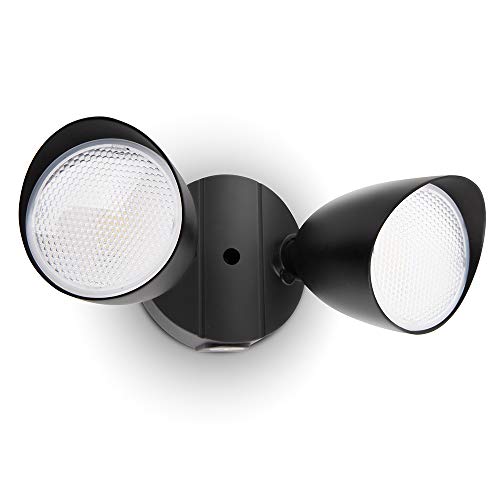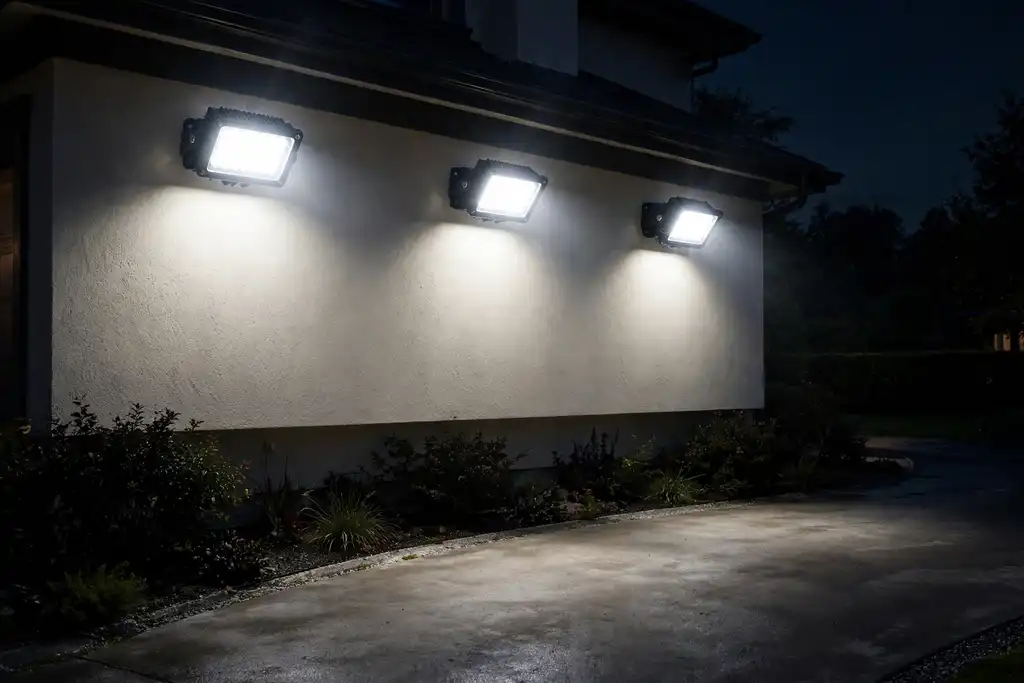
A floodlight on a driveway and a floodlight on a shed share a job, but they do not share conditions. Wide open ground throws light far, while tight corners and deep shadow punish a careless beam.
Owners who guess at beam angle and mounting height often end up with glare, dark patches or a fixture that fails early. We kept those failures in mind while researching the best outdoor led flood light fixtures.
Beam angle, lumens, wattage and weather rating matter most here. We compared brightness at realistic mounting heights, beam spread, housing and IP ratings, and owner reports on glare and long term reliability to narrow down the best outdoor led flood light fixtures.
Top 3 Picks for Best Outdoor Led Flood Light Fixtures

Onforu 75W Flood Lights
- ▸7000 lumens from 112 LEDs
- ▸Three heads cover 270 degrees
- ▸IP65 rated for wet weather

CINOTON 20W 2800LM LED
- ▸2800 lumens per fixture
- ▸Two lights in the pack
- ▸180 degree adjustable knuckle

Onforu 150W LED Security
- ▸15000 lumens from 154 LEDs
- ▸Three heads at 270 degrees
- ▸Matte lens reduces glare
10 Best Outdoor Led Flood Light Fixtures
Outdoor Led Flood Light Fixtures Reviewed
1. Onforu 75W Flood Lights – Three Adjustable Heads
Three Adjustable Heads
PROS
- ✓Wide 270 degree coverage from three heads
- ✓High 7000 lumen output at 75W
- ✓IP65 waterproof for rain and snow
- ✓Aluminum housing for better cooling
- ✓Simple switch operation
CONS
- ✗No motion sensor or dusk to dawn
- ✗Requires hard wiring to a junction box
Onforu 75W Flood Lights Outdoor, 7000LM Brightness…
- 75W output equals 400W traditional bulbs
- Switch controlled, no motion sensor
- Die cast aluminum heat dissipation
- Eave mount to junction box
- 6500K white light color
The Onforu 75W Flood Lights are the pick for buyers who want strong, wide coverage over a driveway or yard. The three heads each adjust independently, so the beam spreads across 270 degrees and reaches corners a single fixed head would miss. At 7000 lumens from 112 LEDs, the output is high for the wattage, and the fixture is rated to use over 85 percent less electricity than an equivalent 400W traditional bulb.
Control is simple by design. There is no motion sensor, no solar panel and no dusk to dawn photo cell, so the light comes on only when someone flips the wall switch. That suits a porch or entryway where you want steady light on demand rather than automatic triggering. The housing is die cast aluminum, which the manufacturer says helps shed heat and extend life, and the IP65 rating means it should handle rain, sleet and snow.
Installation is hard wired, mounting to a junction box with basic wiring steps, so plan for a switch circuit rather than a plug. The black finish and compact dimensions keep it fairly low profile on an eave. For a homeowner who wants bright, manually controlled area lighting and does not need automation, this is a sensible fit.
Best for Wide Area Coverage
This suits homeowners who want to light a broad stretch of yard, driveway or entryway and are happy to control it with a wall switch. The three adjustable heads let you aim light where it is needed instead of relying on one fixed beam.
It also fits buyers replacing an old high wattage floodlight who want similar brightness with far lower running costs. The 7000 lumen output covers a large area, and the IP65 rating keeps it usable through wet weather.
Not Ideal for Automatic Lighting
Skip this if you want a light that switches itself on when someone approaches. There is no motion sensor, no solar charging and no dusk to dawn function, so it stays off until the switch is flipped.
It is also a poor match for anyone without an existing switch circuit or junction box, since installation is hard wired and the fixture will not run from a standard outlet.
2. CINOTON 20W 2800LM LED – Two Pack Value
Two Pack Value
PROS
- ✓Two fixtures in one pack
- ✓Efficient at 140 lumens per watt
- ✓UL listed for safety
- ✓Wall or ground mounting options
- ✓5 year quality warranty
CONS
- ✗Lower output than large floodlights
- ✗No built in motion sensor
CINOTON 20W 2800LM LED Flood Lights Outdoor…
- 20W draws low power
- UL listed, 5000K daylight white
- IP65 waterproof aluminum housing
- Wall or ground mountable
- 5 year quality warranty
The CINOTON 20W 2800LM LED comes as a two pack, which makes it a practical choice for lighting two sides of a garage, a pair of pathways or a barn and its approach. Each fixture puts out 2800 lumens from 28 LED chips, and the manufacturer rates efficiency at 140 lumens per watt, so running costs stay low. The 5000K daylight white color is neutral rather than harsh blue, which reads well over patios and doorways.
The 180 degree arm knuckle with a 1/2 inch NPT thread allows wall mounting or ground mounting, so the same fixture can serve as a wall pack or a landscape light on a post. The die cast aluminum housing is built to dissipate heat, and the maker claims light decay stays below 5 percent over time. IP65 waterproofing covers damp conditions, and the unit is UL listed.
Control is not automatic, so pair it with a switch or an external sensor if you want triggering. For buyers who need several smaller lights rather than one big floodlight, the two pack and the flexible mounting make this an easy fit around a property.
Best for Paired Small Areas
This works well for buyers who need two modest lights rather than one powerful one, such as a garage wall plus a pathway, or a barn and its surrounding yard. The 2800 lumen output per fixture is enough for doorways and small outdoor spaces.
The adjustable knuckle and dual mounting options also suit gardens and patios where you want to aim light down or across a feature. Low power draw keeps long evening use cheap.
Not Ideal for Large Open Areas
Skip this if you need to flood a large driveway or wide yard from a single point. At 2800 lumens per fixture, it is dimmer than high output floodlights and works best in smaller zones.
It also is not the right pick for anyone expecting automatic operation, since there is no motion sensor or dusk to dawn control built in.
3. Onforu 150W LED Security – High Output Security
High Output Security
PROS
- ✓Very high 15000 lumen output
- ✓Wide 270 degree three head coverage
- ✓Matte lens softens glare
- ✓IP65 rated for bad weather
- ✓Aluminum housing for cooling
CONS
- ✗No motion sensor or dusk to dawn
- ✗Junction box not included
Onforu 150W LED Security Light, 15000LM Outdoor…
- 150W output equals 400W bulbs
- Switch controlled, no sensor
- IP65 waterproof rating
- Die cast aluminum housing
- Wall mount to junction box
The Onforu 150W LED Security is the high output option here, with 154 LEDs producing up to 15000 lumens. That is a lot of light for a residential fixture, and the three adjustable heads spread it across 270 degrees so a large yard, garage front or entryway gets even coverage. The maker rates it as equivalent to a 400W high consumption bulb while using over 85 percent less electricity.
The lens uses a professional matte design, which the manufacturer says gives softer light and reduces glare compared with clear lenses. That matters on a bright fixture pointed at a driveway, where harsh glare can be uncomfortable. The die cast aluminum housing is built for heat dissipation and longer life, and the IP65 rating covers rain, sleet and snow.
Like the other Onforu unit, this one is switch controlled only, with no motion sensor, solar or dusk to dawn. It mounts to a wall or eave and wires to a junction box, which is not included. For a big outdoor space where maximum brightness and manual control are the priorities, it covers the job.
Best for Maximum Brightness
This suits buyers who need serious light over a large yard, long driveway or commercial style entryway and are willing to control it by switch. The 15000 lumen output is the highest in this group.
It also fits anyone replacing an old 400W style floodlight who wants the same coverage with lower running costs, and the matte lens helps keep the bright output from becoming harsh.
Not Ideal for Small Spaces
Skip this for a small porch or narrow pathway, where 15000 lumens will be far more light than needed and could bother neighbors. A lower output fixture is a better match there.
It is also not right for anyone wanting automatic switching, since it has no motion sensor, solar panel or dusk to dawn function, and it needs a junction box that is sold separately.
4. Onforu 100w Dusk – Automatic Dusk Sensing
Automatic Dusk Sensing
PROS
- ✓Very high 11000 lumen output
- ✓Automatic dusk to dawn operation
- ✓Three heads adjust to your angle
- ✓IP66 rated for harsh weather
- ✓Switch mode included via black cap
CONS
- ✗Bright output may overwhelm small spaces
- ✗Photocell mode leaves no manual control
Onforu 100w Dusk to Dawn Outdoor Lighting,11000LM…
- 100W with 154 LEDs
- IP66 waterproof rating
- 270 degree beam angle
- Covers about 1150 square feet
- Two optional operating modes
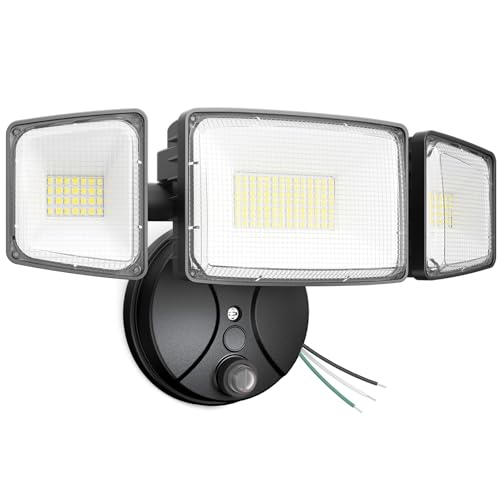
The Onforu 100w Dusk is the pick here for anyone who wants lighting that handles itself after dark. Its built-in photocell switches the fixture on at dusk and off at dawn, so you set the mode once and stop thinking about it. With 154 LEDs pushing 11000 lumens, one unit covers a lot of ground, which cuts down on how many fixtures a large yard or driveway needs.
Three adjustable heads let you aim light where it matters, and the reflective film spreads the beam up to 270 degrees across roughly 1150 square feet. The IP66 rating means rain, sleet and snow should not stop it, which matters for exposed walls and outbuildings. Owners commonly note the convenience of the automatic mode, and a supplied cap lets you convert it to plain switch control when you want manual operation.
For security around a garage, barn or yard, the automatic operation is the real draw. We looked at the sensor thresholds, 10 to 20 lux to switch on and 30 to 60 lux to switch off, and they line up with normal night and daylight levels. The main trade-off is that this is a big, bright fixture, so it suits larger outdoor spaces better than tight patios.
Best for Hands-Off Security Lighting
This suits homeowners who want exterior security light without touching a switch every night. The photocell handles on and off automatically, which is handy for garages, yards and outbuildings that sit dark for long stretches.
It also fits large areas that need serious coverage. The 11000 lumens and three aimable heads mean fewer fixtures to buy and wire, and the IP66 body should hold up through wet winters.
Not Ideal for Small Spaces
Skip this if you need light only when you choose. In dusk to dawn mode the fixture runs all night, so anyone wanting quick manual bursts should use the capped switch mode or a different model.
It is also overkill for porches and small patios. The high output and wide spread are built for big outdoor areas, and a smaller fixture will be easier to place and less likely to glare.
5. Onforu 3200LM Flood Lights – Simple Switch Control
Simple Switch Control

PROS
- ✓Bright 3200 lumens from only 32W
- ✓Two heads adjust for coverage
- ✓IP66 rated for wet weather
- ✓Aluminum body aids heat dissipation
- ✓Matte lens reduces glare
CONS
- ✗No motion sensor or dusk sensor
- ✗Requires a switched circuit and wiring
Onforu 3200LM Flood Lights Outdoor, 32W 6500K…
- 32W replaces 200W bulbs
- IP66 waterproof design
- Switch controlled only
- Matte anti-glare lens
- Wall mount junction box install
The Onforu 3200LM Flood Lights keeps things simple. There is no motion sensor, no solar panel and no photocell, so the fixture turns on and off only from a wall switch. For buyers who want direct control over when their outdoor lighting runs, that is a plus rather than a limitation. The 32W unit puts out 3200 lumens, roughly matching a 200W traditional bulb while using far less power.
Two adjustable heads let you aim light toward a driveway, entryway or side yard, and the matte lens is designed to soften glare compared with bare LEDs. The die-cast aluminum body helps dissipate heat, which owners often note as a factor in long-term reliability. An IP66 rating means heavy rain and snow should not be an issue, and it hardwires to a junction box like a standard exterior fixture.
We see this as a good fit for garages, entryways and yards where a switch inside the door already controls the light. The 6500K color is cool and crisp, which reads well for security. The catch is that nothing happens automatically, so it depends entirely on someone flipping the switch.
Best for Switch-Controlled Exteriors
This is a sensible choice for anyone who already has a wall switch wired to an exterior light and wants brighter, more efficient output. Garages, entryways and yards are the natural spots.
It also suits people who dislike automatic sensors turning lights on at odd times. The two heads let you cover a doorway and a path from one fixture, and the aluminum build should handle heat and weather.
Not Ideal for Unattended Areas
Skip it if the light needs to come on by itself. With no photocell or motion sensor, a dark shed or remote gate stays dark until someone uses the switch.
It is also a poor match for renters or anyone without an existing switched circuit. Hardwiring to a junction box is required, so installation depends on the wiring already in place.
6. LUTEC 6222W 3500 Lumen – Full Metal Dual Head
Full Metal Dual Head

PROS
- ✓Full aluminium and PC construction
- ✓Heads rotate a full 360 degrees
- ✓3500 lumens at 5000K daylight white
- ✓Waterproof for outdoor mounting
- ✓Three-year warranty
CONS
- ✗Lower output than high-lumen models
- ✗White finish may not suit every exterior
LUTEC 6222W 3500 Lumen 32 Watt 28…
- 32W at 5000K daylight white
- Aluminium and PC build
- Dual adjustable light heads
- Waterproof exterior rating
- Three-year warranty included
The LUTEC 6222W 3500 Lumen is a dual-head wall fixture with a full metal design in aluminium and polycarbonate. At 32W it produces 3500 lumens of 5000K daylight white light, which sits between warm and very cool output and reads naturally on patios and walkways. The two heads rotate through 360 degrees, so you can spread coverage across a corner or aim both at one dark entry.
Build quality is the selling point here. The aluminium body should resist rust and handle outdoor exposure, and the waterproof rating supports use in gardens, yards and entryways. LUTEC backs it with a three-year warranty, which is worth noting for a fixture mounted where weather hits hardest. Owners commonly mention the adjustable heads as the feature they use most.
We think this fits patios, garden walls and side entries where looks matter as much as output. The white finish and metal housing suit house exteriors better than utilitarian black boxes. Output is lower than the biggest units, so it is better for focused coverage than flooding a whole lot.
Best for Patios and Walkways
This suits homeowners lighting a patio, garden wall or entryway where a neat metal fixture matters. The white finish and dual heads blend into house exteriors better than bulky black units.
It also fits buyers who value a warranty and metal build over raw brightness. The 3500 lumens are enough for paths and doorways, and the rotating heads let you cover two directions from one mount.
Not Ideal for Large Open Areas
Skip it if you need to flood a big driveway or yard. At 3500 lumens it is dimmer than the high-output options here, so large open spaces may need more than one fixture.
It is also a weaker choice for buyers who want automatic operation. There is no sensor built in, so the light depends on a switch or separate control.
7. Lithonia Lighting HomeGuard 2-Light – Aiming Control with Visors
Aiming Control with Visors
PROS
- ✓Tool-less head aiming
- ✓Integrated glare-reducing visors
- ✓Solid die-cast aluminum build
- ✓Wet location listed
- ✓Five-year limited warranty
CONS
- ✗No built-in motion sensor
- ✗LEDs are not replaceable
Lithonia Lighting HomeGuard 2-Light LED Outdoor Flood…
- 2750 lumens at 4000K
- IP65 rated die-cast aluminum
- Wall or ceiling mount
- Wet location listed
- 5-year limited warranty
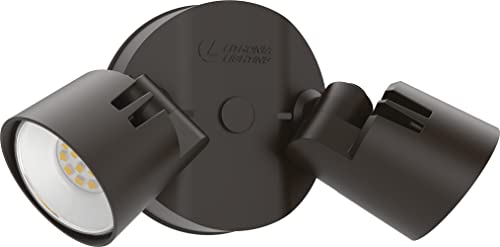
This fixture suits homeowners who want a clean, aimable wall or ceiling light for a yard, driveway or walkway. The two round heads adjust without tools, and the integrated visors cut glare so the light lands where you point it instead of spilling into windows. At 2750 lumens and 4000K, output is modest but even, which fits residential security lighting rather than wide-area coverage.
The housing is rugged die-cast aluminum with an IP65 rating, and it is listed for wet locations when mounted at least four feet above ground. Owners commonly report that the bronze finish holds up and the fixture feels solid for a residential unit. One thing to plan around is control. There is no built-in sensor, so it runs from your existing wall switch, and sensor versions are sold separately.
We also noted that the LEDs are not replaceable, so the fixture is a long-term commitment rather than a serviceable one. The five-year limited warranty and the -40°C to 40°C operating range give it credibility for cold climates. Mounting hardware and a crossbar are included, and it supports top, end or back mount with the canopy. For a tidy, glare-controlled install near the house, this is a sensible pick.
Best for Aimed Residential Lighting
This suits homeowners lighting a driveway, walkway or yard who want to aim light precisely and keep glare down. The adjustable heads and visors make it easy to direct output away from windows and doors.
It also fits anyone replacing an old incandescent security light on a switched circuit. The modest 2750 lumens is enough for residential coverage without washing out the whole street.
Not Ideal for Wide Area Coverage
Skip it if you need to flood a large parking area or long driveway. At 2750 lumens, it is a residential security light, not a high-output area light.
It is also a poor fit if you want automatic operation out of the box. There is no sensor built in, so you will need a separate sensor version or your own switching.
8. CINOTON 50W 7000LM LED – High Output Wide Voltage
High Output Wide Voltage

PROS
- ✓7000 lumens high output
- ✓100-277V input flexibility
- ✓Enhanced surge protection
- ✓180° adjustable knuckle mount
- ✓ETL certified with 5-year coverage
CONS
- ✗No built-in light sensor
- ✗Bright 5000K may be harsh near homes
CINOTON 50W 7000LM LED Flood Lights Outdoor…
- 7000 lumens, 140 lumens per watt
- 100-277V input flexibility
- IP65 die-cast aluminum housing
- 180° adjustable NPT knuckle
- ETL certified, 5-year coverage
This one is built for bigger spaces and less predictable electrical setups. The 100-277V input means it can replace or add lighting in workshops, barns, warehouses and garages where standard 120V is not the only supply on site. Output is 7000 lumens at 5000K daylight from 60 LED chips, at 140 lumens per watt, so it covers large outdoor areas with a wide, bright spread.
We like the attention to electrical reliability. Enhanced surge protection adds a layer of defense for outdoor installs where power conditions vary. The die-cast aluminum housing helps dissipate heat, and the IP65 rating protects against rain and moisture, with a rated life up to 50,000 hours. The 180° adjustable 1/2 inch NPT knuckle supports wall or ground mounting, so you can aim it where it is needed.
Owners commonly report strong brightness for the size and straightforward mounting. It is ETL certified and backed by five-year service coverage plus a 45-day refund window. One caveat is that this version has no light sensor, so it needs a switch or separate control. For a garage, barn or landscape install that needs serious output and voltage flexibility, it is a strong fit.
Best for Large Outbuildings
This suits garages, barns, workshops and warehouses that need high output and can supply anything from 100V to 277V. The wide input range makes replacement and expansion simpler.
It also works well for large yards and landscape areas where one bright, aimable fixture needs to cover a lot of ground.
Not Ideal for Small Patios
Skip it for a small patio or entryway where 7000 lumens would be overwhelming. This is an area light, not a subtle accent.
It is also a poor fit if you want automatic dusk-to-dawn or motion operation. This version has no sensor, so it relies on a switch or separate controls.
9. Onforu 75W Flood Lighting – Three Adjustable Heads
Three Adjustable Heads

PROS
- ✓Two fixtures in the pack
- ✓Three aimable heads per light
- ✓7000 lumens per fixture
- ✓IP65 rain, sleet and snow rating
- ✓Energy saving versus 400W bulbs
CONS
- ✗No motion sensor or dusk-to-dawn
- ✗6500K is very cool and harsh
Onforu 2 Pack 75W Flood Lights Outdoor…
- 7000 lumens, 75W, 6500K
- Three heads, 270° adjustable
- Switch controlled only
- Aluminum fin heat sink
- Two-pack, IP65 rated
This two-pack is aimed at broad yard and driveway coverage. Each 75W fixture uses 112 LED beads to produce up to 7000 lumens at 6500K, which the maker compares to a 400W traditional bulb while saving about 85 percent on electricity. The three heads adjust through 270 degrees, so you can spread light across a wider area and see more of what is happening in the yard.
Control is simple and deliberate. These lights turn on and off only by wall switch, with no motion sensor, no solar and no dusk-to-dawn. That suits people who want manual control and no false triggers. The aluminum housing uses a fin-type heat sink for cooling, which helps with lifespan and safe operation, and the IP65 rating covers rain, sleet and snow.
Owners commonly report good brightness for the money and appreciate getting two fixtures in the pack. The 6500K color is very cool and crisp, which reads as security lighting rather than warm ambience. For garages, workshops, yards, driveways and parking areas where you want wide, switch-controlled coverage, this pair covers a lot of ground at a reasonable outlay.
Best for Wide Yard Coverage
This suits anyone lighting a large yard, driveway or parking area who wants wide coverage from adjustable heads. Three aimable heads per fixture spread light where you need it.
It also fits users who prefer manual switching over sensors. There are no false triggers and no dusk-to-dawn setup to fuss with.
Not Ideal for Automatic Security
Skip it if you want lights that come on by themselves. There is no motion sensor and no dusk-to-dawn, so it only works from a wall switch.
It is also a poor fit for warm, welcoming entry lighting. The 6500K output is very cool and bright, which suits security more than ambience.
10. Lithonia Lighting Adjustable Twin – Twin Head Aiming Control
Twin Head Aiming Control

PROS
- ✓Two heads aim independently for coverage
- ✓Accepts common PAR medium base bulbs
- ✓Weather and rust resistant aluminum body
- ✓Gasket included for wet locations
- ✓Simple hardwired switch operation
CONS
- ✗Bulbs are not included in the box
- ✗Wall or eave mount only, no ground use
Lithonia Lighting Adjustable Twin Par Flood Light…
- Two PAR medium base sockets, 150W each
- Tool free up, down and side aiming
- Die cast aluminum canopy and holders
- Wall or eave mount only
- Hardwired on/off switch operation
The Lithonia Lighting Adjustable Twin is a bare holder rather than a sealed unit, so it takes two outdoor rated PAR medium base bulbs up to 150W each. That open design gives you freedom to choose beam spread and color temperature by picking the lamps yourself. In our research, this kind of holder appeals to people who already know what lamp they want over a driveway or patio.
The catch is that bulbs are not included, so the total cost depends on what you pair with it.
Aiming is the practical strength here. Both heads adjust up and down and side to side without tools, which lets you point light at a gate, a walkway or a parked car instead of a single fixed wash. The die cast aluminum canopy and socket holders are built to resist weather and rust, and a gasket is included. It is cUL listed and rated for wet locations, so rain exposure on a wall or eave is within its intended use.
Installation is straightforward but limited. The fixture mounts to a junction box and is designed for wall or eave mounting only, not for ground stakes or post tops. It runs from a hardwired on/off switch, so there is no motion sensing or photocell built in. Owners commonly note that the white finish blends into light colored siding, and the one year limited warranty is modest for a permanent outdoor fitting.
Best for Custom Bulb Setups
This suits homeowners who want to choose their own PAR lamps for brightness and beam angle. Two aimable heads cover a driveway edge and a door in one fitting.
It also fits light commercial spots where a hardwired switch already exists and a simple, serviceable holder is preferred over an integrated LED unit.
Not Ideal for Plug and Play
Skip it if you want light out of the box. You still need to buy two outdoor rated bulbs before anything works.
It is also a poor fit for anyone wanting motion detection, dusk to dawn control or post mounting, since none of those are part of this design.
How to Choose the Best Outdoor Led Flood Light Fixtures
Start with the Conditions the Fixture Will Face
Outdoor flood lights live in a harder environment than almost any other light in a home. Rain, snow, dust, insects and sun all work on the housing year after year. That is why we looked first at how each fixture is sealed and rated, not just at brightness. A light that runs hot or lets water in will fail long before its LEDs wear out.
Placement matters just as much. A fixture mounted under an eave sees less direct rain than one on an open wall or a pole. Coastal air adds salt, and inland areas with heavy winter snow put weight and freeze cycles on the housing and bracket. Our research focused on lights that hold up in these real outdoor positions, based on product data and what owners report after long term use.
Heat is the quiet risk. LEDs and their drivers generate heat, and a sealed outdoor housing traps it. Fixtures with generous metal bodies and proper heat paths tend to last longer than compact units pushed to high output. We compared housing designs and wattages with this in mind.
Read the IP and Weather Ratings Properly
The IP number is the first thing to check on any outdoor fixture. The first digit covers solids like dust, and the second covers water. IP65 means dust tight and protected against water jets, which suits most wall and eave mounting. IP66 handles stronger jets, and IP67 survives brief immersion, which rarely matters for a flood light but signals a very tight seal.
A high IP rating is only useful if the seals stay intact. Gaskets around the lens and cable entry are the usual failure points. We looked at how each housing closes and whether the cable entry is protected. Owners commonly report that water gets in through poorly sealed cable glands, so that detail counts.
Many flood lights also carry a wet location or outdoor listing from a safety body. That listing confirms the fixture was assessed for damp and wet positions, not just dry indoor use. We treated a proper outdoor listing as a baseline requirement, not a bonus.
Lens, Optics and Light Quality
The lens shape decides how the light spreads. Flood lights usually throw a wide beam, often around 100 to 120 degrees, which suits driveways, yards and building fronts. Some models use reflectors or lenses to push light further with less spill. We compared beam descriptions and typical coverage so the spread matches the job.
Colour temperature is the other number to watch. Most outdoor floods sit between 5000K and 6500K, a cool white that reads as bright and alert. Warmer options near 3000K to 4000K feel softer and suit seating areas or entries. Colour rendering also matters, because a light with poor rendering makes plants, paint and faces look flat.
Glare control separates a good flood light from an annoying one. A bare LED panel aimed at eye level can blind neighbours and wash out the scene. Shielded lenses, deeper housings and careful aiming all reduce glare. We favoured fixtures whose design gives some control over where the light lands.
Frame, Shape and Mounting Types
Housing material drives both durability and weight. Die cast aluminium handles heat and weather well and resists corrosion when coated. Tough polycarbonate or plastic housings cost less and resist impact, but they can yellow or crack over years of sun. We compared materials across the range and noted where each makes sense.
Shape affects where a fixture can go. Compact single head units fit tight walls and soffits. Twin head designs, like the Lithonia Lighting HomeGuard 2-Light and the Lithonia Lighting Adjustable Twin, cover two directions from one mount, which suits corners and garage fronts. Larger panels such as the Onforu 150W LED Security and the CINOTON 50W 7000LM LED throw more light over open ground.
Mounting hardware is easy to overlook. Adjustable brackets let you aim the beam after fitting, while fixed brackets rely on careful placement. We checked bracket range and fixing points, because a stiff or limited bracket makes aiming a chore. Owners often mention that easy aiming saved them a second round on the ladder.
Fit Features: Motion, Dusk to Dawn and Controls
Motion sensing changes how a flood light behaves. A sensor turns the light on when something moves, which saves power and draws attention to the area. Detection range and angle vary, and mounting height affects both. We compared sensor specs so you can match coverage to a driveway, path or back door.
Dusk to dawn operation keeps a light on from evening to morning using a photocell. Models like the Onforu 100w Dusk and the CINOTON 20W 2800LM LED suit areas that need steady overnight light. The trade off is constant power draw, so output and efficiency matter more here.
Manual controls and modes add flexibility. Some fixtures offer adjustable sensitivity, timers or selectable colour temperatures. We looked at which settings are easy to reach and set without tools. Simple, clearly marked controls tend to age better than fiddly ones exposed to weather.
Power, Compatibility and Long Term Care
Wattage and lumens tell you the output, and the ratio between them shows efficiency. Modern LED floods often deliver around 100 to 140 lumens per watt, so a 20W unit can reach roughly 2800 lumens and a 50W unit around 7000 lumens. We used these figures to compare models like the Onforu 75W Flood Lights and the LUTEC 6222W 3500 Lumen on a like for like basis.
Check what the fixture connects to before buying. Most outdoor floods run on standard mains voltage and wire into an existing junction box, but sensor and photocell models need that circuitry built in or added. If you plan to pair a light with a switch, timer or smart plug, confirm the fixture works with simple on and off switching. We noted compatibility where product data made it clear.
Long term care is mostly about inspection. Cleaning the lens and checking seals once or twice a year keeps output steady and catches water ingress early. Trimming plants away from the housing helps heat escape and stops debris collecting. We included care notes because the fixtures that last are usually the ones that get a little attention.
Our Research Process
To assemble these recommendations, we examined the outdoor LED flood light specs that carry the most weight, and then verified how owners find them performing in real use.
- Protection: IP ratings and weather resistance were weighed, as these units stay outdoors all year and dampness is the leading reason fixtures fail prematurely.
- Fit: Mounting choices, beam angles and physical measurements were reviewed so every selection works on walls, eaves or the ground without clumsy brackets.
- Materials: Housing materials, lens design and heat management were assessed, since weak heat dissipation cuts LED lifespan short.
- Owner feedback: Owner reviews were scanned for recurring issues, including flickering, water getting in, sensor failures or overstated lumen figures.
- Expert guidance: Recommendations from lighting engineers and electricians were heeded regarding beam spread, colour temperature and the right wattage for security lighting versus general illumination.
Each product listed here secured its spot based on its published specs and the overall pattern of owner experience, rather than one rave review.
FAQs on Best Outdoor Led Flood Light Fixtures
What Lens Type Should I Look for in Outdoor Led Flood Light Fixtures?
The lens is the first thing we check when comparing outdoor led flood light fixtures. Clear tempered glass keeps the most light output but throws a hard, glary beam that can bother neighbours. Frosted or textured polycarbonate lenses soften the beam and spread it more evenly, which suits driveways and patios. For coastal or dusty sites, we look for sealed glass rather than open designs, because grit and salt fog up plastic over time.
Material choice matters just as much as lens finish. Aluminium housings with a powder coat resist rust better than thin steel, and stainless fixings stop the screws seizing after a wet winter. Owners often report that cheap plastic bodies yellow and crack after a few seasons of sun.
How Do I Choose the Right Size Outdoor Led Flood Light Fixtures for a Large Yard?
Sizing outdoor led flood light fixtures is about beam spread and mounting height, not just wattage. A narrow beam from a high mount lights a long path, while a wide beam from a low wall covers a patio. We compare the stated beam angle against the area you need to cover, then check the lumen output matches the distance. Too much output on a short throw creates harsh glare and wasted light.
Fit also means the bracket and cable entry. Check the mounting arm can tilt and lock at the angle you need, and that the cable gland faces down so water cannot run in. For large yards, several mid power fixtures spread evenly usually beat one huge unit. Owners commonly report that a single oversized flood leaves dark corners, so plan coverage across the whole space before you buy.
Are Outdoor Led Flood Light Fixtures Safe to Use Near Water and Wet Ground?
Safety with outdoor led flood light fixtures comes down to the IP rating and the wiring. We look for IP65 or IP66 for rain and hose spray, and IP67 if the fixture sits low or near a pond. The driver and connections must be sealed too, since water often gets in at the cable entry rather than the lens. A fixture rated for wet locations should say so clearly on the label.
Installation matters as much as the rating. We advise mounting fixtures so the cable gland points down and joints sit in a sealed box above ground level. For anything near water, a residual current device on the circuit is standard practice and worth confirming with a qualified electrician.
How Should I Care for Outdoor Led Flood Light Fixtures Through Winter?
Care for outdoor led flood light fixtures is mostly about keeping the lens clear and the seals intact. We suggest wiping the glass a few times a year with a soft cloth and mild soap, because dirt and bird mess cut output and trap moisture. Check the gasket and cable gland each season and replace any cracked seal before the wet months arrive. Loose screws and tired brackets let water in and cause flicker.
Winter brings frost, salt and wind load, so we compare how each fixture drains and whether the housing sheds water. Owners in cold regions often report condensation inside poorly vented units, which fogs the lens and shortens driver life. Look for a breather valve or a well sealed design, and make sure snow cannot pile against the driver compartment.
What Budget Should I Set for Outdoor Led Flood Light Fixtures That Last?
Budget for outdoor led flood light fixtures should cover the housing, the driver and the seal, not just the LED chip. We compare fixtures by build quality first, because a cheap driver is the part that fails first in heat and cold. Spending a little more on an aluminium body and a reputable driver usually pays back over the fixture’s life. Very low prices often mean thin metal and a short warranty.
Our research suggests weighing the warranty length and the stated lifetime hours as a rough guide to confidence. A longer warranty usually signals a maker that trusts its driver and sealing. Factor in the cost of an electrician if you need new wiring or a higher mount, since that can exceed the fixture price.
Why Do My Outdoor Led Flood Light Fixtures Flicker and How Can I Avoid It?
Flicker in outdoor led flood light fixtures usually points to the driver, the dimmer or a poor connection. We compare driver quality closely, because cheap drivers struggle in cold weather and can cause visible pulsing. A loose cable gland letting damp in is another common cause, and so is a dimmer that is not rated for LED loads. Check the wiring and the switch first before blaming the light.
To avoid it, buy fixtures with a reputable driver and a clear IP rating, and match any dimmer to the fixture’s LED compatibility. Owners report that flicker often starts after a wet spell, which suggests moisture at the joint rather than the LED itself. If the unit is sealed and the wiring is sound, the driver is the likely culprit.
Conclusion
Our overall pick is the Onforu 75W Flood Lights, which balance strong light output with a manageable size for most yards. If you want a lower-wattage option for smaller areas, the CINOTON 20W 2800LM LED suits tight spaces, while the Onforu 150W LED Security fits larger properties that need broader coverage.
We based these picks on product data, owner feedback and expert research, comparing brightness, build quality and reported reliability rather than hands-on testing. Owners commonly mention ease of installation and steady performance over time.
One last piece of advice: match the beam angle and lumen output to the area you need to light, since an oversized fixture can create glare and waste energy.