
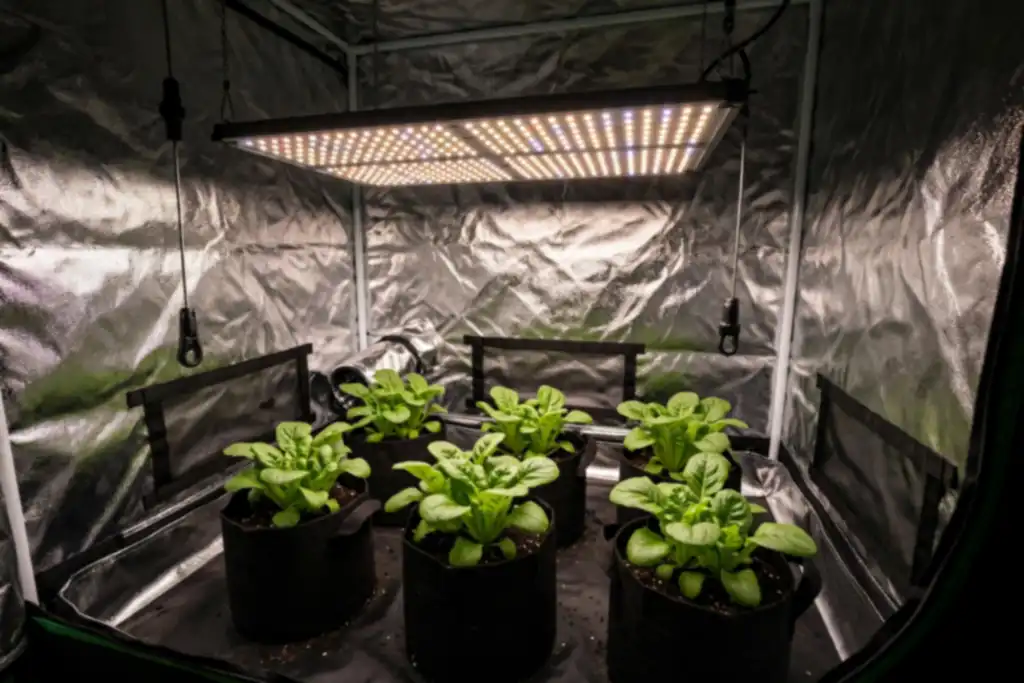
Many growers believe a 3×3 LED grow light must be enormous to cover a small tent. In fact, a compact fixture built around efficient diodes can light a 3×3 space well without taking over the room.
You are likely a home grower with a small tent or a dedicated corner. Without the right fixture, plants stretch, flowering suffers, and power goes to waste. Our research points to the best 3×3 led grow light for compact spaces.
Horticulturists recommend matching light spread to canopy size, not just wattage. We compared diode efficiency, coverage at 3×3, heat output, and dimming control across models like the Spider Farmer SF1000 and VIVOSUN LumaLight. That work shaped our pick for the best led grow light.
Top 3 Picks for Best 3×3 Led Grow Light

Barrina GrowForce BG02 200W
- ▸Dual blue and far red
- ▸684 high efficiency LEDs
- ▸Daisy chain up to 100

260W LED Grow Lights
- ▸Daisy chain 100+ lamps
- ▸IP65 waterproof beads
- ▸Fanless silent operation

ECOHOM Bar 320W LED
- ▸2.8 umol/J efficacy
- ▸Detachable driver cuts heat
- ▸IP66 waterproof rating
10 Best 3×3 Led Grow Light
3×3 Led Grow Light Reviewed
1. Barrina GrowForce BG02 200W – Focused Lens Spectrum
Focused Lens Spectrum
PROS
- ✓Strong system efficiency at 2.9 umol/J
- ✓Lensed red and IR for canopy penetration
- ✓Dimmable with wide height adjustment
- ✓Daisy chain up to 100 units
- ✓ETL certified construction
CONS
- ✗Rated coverage extends beyond a square footprint
- ✗Push button control only, no external controller
Barrina GrowForce BG02 200W, 3 x 3…
- 200W full spectrum output
- System PPE of 2.9 umol/J
- Light output 2401 umol/m2/s
- 60 degree lenses on red and IR
- ETL certified for safety
The Barrina GrowForce BG02 200W is the pick we would point to first for a square canopy setup. Its 200W draw and system level PPE of 2.9 umol/J give it real output for its class, and the rated light output of 2401 umol/m2/s is strong for a footprint this size.
The 684 LEDs each carry a PPE of 3.14 umol/J, so the efficiency is spread across the whole board rather than concentrated in a few diodes.
What sets this one apart in our research is the spectrum work. Blue light at 437nm supports sugar accumulation in roots and stems, while 730nm far infrared helps with full fruit development. The red and IR beads use 60 degree lenses to push energy deeper into the canopy, which matters when plants grow tall and lower sites start to shade out. Dimmable brightness and height adjustment let you tune it across growth stages.
Coverage is rated for areas up to 4x4FT, so it leaves headroom around a square tent footprint. The daisy chain supports up to 100 units for synchronized control, and the aluminum build keeps the fixture rigid. ETL certification covers the quality and compliance side. For a single tent or a small multi light room, this is a well rounded option that does not force a choice between spectrum and output.
Best for Single Tent Grows
This suits growers running one square tent who want a fixture with enough reach to cover the corners. The 4x4FT rated coverage means a smaller footprint sits comfortably inside the light spread, which helps keep edge plants from stretching.
It also fits anyone who wants spectrum control without adding supplements. The blue and far red blend plus the 60 degree lenses on the red and IR beads do work that usually needs extra fixtures, and the dimmer covers seed starting through flower.
Not Ideal for Large Rooms
Skip this if you are lighting a large room in one go. The daisy chain helps with control, but the 200W class means you will need several units to fill bigger spaces, and the cost adds up quickly.
Growers who rely on an external 0-10V controller should look elsewhere. This fixture uses push button control, so automation and central dimming are not part of the package.
2. 260W LED Grow Lights – Quiet Waterproof Bar
Quiet Waterproof Bar
PROS
- ✓IP65 rating with spray glued beads
- ✓Fanless design with no noise
- ✓Manual or 0-10V external dimming
- ✓Master and slave control modes
- ✓Daisy chain over 100 lamps
CONS
- ✗No lensing details for red or IR output
- ✗Fewer published efficiency figures than rivals
260W LED Grow Lights 3×3 Growing Bar…
- 260W full spectrum output
- Manual or 0-10V dimming
- Master and slave modes
- Aluminum bar heat dissipation
- Spray glued waterproof beads
The 260W LED Grow Lights is built around a bar format, and the size is stated as suitable for a square tent. At 260W it sits a step above the entry class, which gives it more headroom for flowering plants that need stronger intensity. The aluminum bars handle heat dissipation without a fan, so there is no noise and no extra cooling gear to buy.
Dimming is flexible in a way that suits mixed setups. You can adjust intensity with the button or run it from an external 0-10V controller, and master and slave modes let you set the first light and control the rest from there. The daisy chain supports up to 100 or more lamps dimmed together, which is handy for grow rooms and greenhouses.
Water resistance is the detail we kept coming back to. The full spectrum beads have a spray gluing process and the fixture carries an IP65 rating, so splashes during watering are less of a worry. The powder coated aluminum finish looks durable, and the rectangular shape hangs cleanly from a ceiling mount. For a tent where humidity runs high, that protection is worth having.
Best for Humid Grow Tents
This is a good match for growers who water by hand and worry about splashes. The IP65 rating and spray glued beads mean a wet spill is less likely to end the run, which is a real concern in a crowded tent.
It also suits people building a multi light room. Master and slave modes plus 0-10V control make it easy to dim a whole bank from one point, and the fanless bars keep the noise down in shared spaces.
Not Ideal for Spectrum Tinkerers
If you want detailed spectrum control, look at fixtures that publish red and far red specifics. This one lists a full spectrum output but gives no lens or wavelength detail for tuning.
Growers who compare fixtures on efficiency numbers will find less to work with here. The listing does not publish PPE or PPFD figures, so it is harder to benchmark against the competition.
3. ECOHOM Bar 320W LED – Detachable Driver Power
Detachable Driver Power
PROS
- ✓High 2.8 umol/J efficacy at 320W
- ✓Detachable driver lowers tent heat
- ✓IP66 rating for humid rooms
- ✓Stepless 0-100% dimming
- ✓Retractable bars fit varied spaces
CONS
- ✗Daisy chain limited to 50 units
- ✗Higher wattage needs more clearance from plants
ECOHOM Bar 320W LED Grow Light, Full…
- 320W stable output
- 380nm to 780nm full spectrum
- 660nm deep red and 730nm far red
- 0-100% stepless dimming
- Daisy chain up to 50 units
The ECOHOM Bar 320W LED is the most powerful fixture in this group, and the numbers back it up. It delivers 2.8 umol/J efficacy with what the listing describes as exceptional PAR uniformity across a square footprint. The open bar layout is designed to avoid hot spots and push light deeper into the canopy, with a claimed 40 percent higher PPFD than other lights in its class.
The spectrum runs from 380nm to 780nm and combines 3000K warm white, 5000K daylight, 660nm deep red and 730nm far red. That far red band is aimed at faster flowering initiation and a stronger phytochrome response, so the fixture covers seed starting through veg and bloom. Dimming is stepless from 0 to 100 percent, and up to 50 units can run from a single outlet with master dimmer control.
The detachable driver is the feature we think matters most in a tent. Moving it outside reduces ambient heat by 2 to 5 degrees C, which extends LED lifespan and lowers cooling costs. The IP66 rating handles high humidity, the retractable bars adjust to different spaces, and the kit includes steel ropes, nylon hangers, a power cord and screws. Aluminum construction and passive cooling keep it fanless.
Best for Heat Sensitive Setups
This fits growers in small or sealed rooms where heat builds fast. The detachable driver can sit outside the tent, cutting ambient heat by 2 to 5 degrees C and easing the load on extraction and cooling gear.
It also suits commercial or semi commercial runs. The 320W output, 120 to 277V operation and surge protection point to steady duty, and the retractable bars let one fixture adapt to different bench and shelving layouts.
Not Ideal for Tight Budgets
Skip this if you are lighting a very small seedling shelf. At 320W it is more fixture than a young canopy needs, and the dimmer helps but the upfront cost is higher than the entry options.
Growers planning very large banks of lights should note the daisy chain cap. It connects up to 50 units per outlet, so bigger rooms need planning around multiple circuits.
4. KingLED KP2000 200W Grow – Built-In Airflow Fans
Built-In Airflow Fans

PROS
- ✓Fans keep air moving around foliage
- ✓Simple VEG and BLOOM switches
- ✓Covers all growth stages
- ✓Fits 2×4 and 3×3 tents
- ✓Straightforward hanging setup
CONS
- ✗Not dimmable, height is the only control
- ✗Modest penetration in dense canopies
KingLED KP2000 200W Grow Light for Indoor…
- 200W full spectrum LED
- 6680 lumens maximum output
- Blue, red and white diodes
- Not dimmable, on-body switches
- Hanging mount, 120V
The KingLED KP2000 is a 200W full spectrum panel that the maker recommends for 2×4 tents but also lists as fitting 3×3 spaces. In a square setup of that size, the rectangular shape means some light spills past the walls, so we suggest centering it and checking the corners. It runs on 120 volts and puts out a maximum of 6680 lumens, with blue 460 nm, red 660 nm and white 3000K to 5000K diodes covering germination through flowering.
What owners commonly mention is the built-in fans. Air moves through openings in the panel and helps refresh the air around leaves, which matters in a small square space where heat and humidity build quickly. The on-body VEG and BLOOM switches let you run seedlings on VEG and add BLOOM later, with both on during flowering if you want more output. There is no dimmer, so height adjustment is your main control.
For a square footprint, the maker itself points buyers toward a larger model for deeper penetration, and very dense canopies may need side or in-canopy light. We see this panel as a reasonable fit for beginners running a small tent with moderate plant counts. If you plan a packed, layered canopy, budget for extra lighting.
Best for Small Beginner Tents
This suits growers setting up a small square or 2×4 tent who want one panel for the whole cycle. The VEG and BLOOM switches keep operation simple, and the fans help with airflow in tight spaces.
It also works for supplemental light outside a tent, with about 5.6×5.6 ft coverage when hung 6 ft above the floor. Coverage depends on height and plant needs, so check your layout.
Not Ideal for Dense Canopies
Skip it if you run a packed, layered canopy in a square tent. The maker recommends a larger model for deeper penetration, and very dense foliage may need side or in-canopy light.
It is also a poor match for anyone who wants fine brightness control. There is no dimmer, so you manage intensity by changing hanging height instead.
5. 320W LED Grow Lights – Dimmable Daisy Chain Bars
Dimmable Daisy Chain Bars

PROS
- ✓Dimmable from 0 to 100 percent
- ✓Links up to 20 lights
- ✓IP65 waterproof rating
- ✓Foldable bars for easy handling
- ✓Ropes and hooks included
CONS
- ✗277 volt rating needs checking
- ✗PPFD figure quoted at 3×3 and 4×4, not one size
320W LED Grow Lights, Full Spectrum LED…
- 320W commercial full spectrum
- 5-level dimming knob
- RJ12 daisy chain ports
- Foldable aluminum bars
- Honeycomb heat dissipation
The 320W LED Grow Lights is a bar style fixture built around a commercial full spectrum, mixing 6200K white, 437.5 nm blue and 730 nm deep red. The maker rates it at 3.0 µmol/m²/s PPFD over 3×3 and 4×4 ft coverage, which puts it in range for a square tent at the smaller end. Foldable aluminum bars and a honeycomb design are claimed to cut temperatures and light attenuation.
For a square space, the dimming is the useful part. A 5-level knob takes brightness from 0 to 100 percent, so you can soften output for seedlings and raise it for flowering without moving the light. RJ12 ports let you connect up to 20 lights from one master, which suits multi-tent rooms. The IP65 rating and anodized coating are aimed at humid environments.
Setup is simple, with adjustable ropes and hooks and no extra tools. We think this fits growers who want a bar light over a square canopy and value dimming plus linking. The 277 volt rating is worth confirming against your supply before ordering.
Best for Dimmable Multi-Light Rooms
This suits growers running one or several square tents who want brightness control at each stage. The knob makes it easy to lower output for young plants and raise it for bloom.
It also fits commercial or multi-light setups, since RJ12 ports link up to 20 fixtures from one master. The IP65 rating helps in humid rooms.
Not Ideal for Standard 120V Only
Check your supply first if you only have standard household voltage. The fixture is rated at 277 volts, so confirm compatibility before buying.
Skip it if you want a simple plug and play panel with no wiring thought. Linking and voltage checks add planning that basic panels avoid.
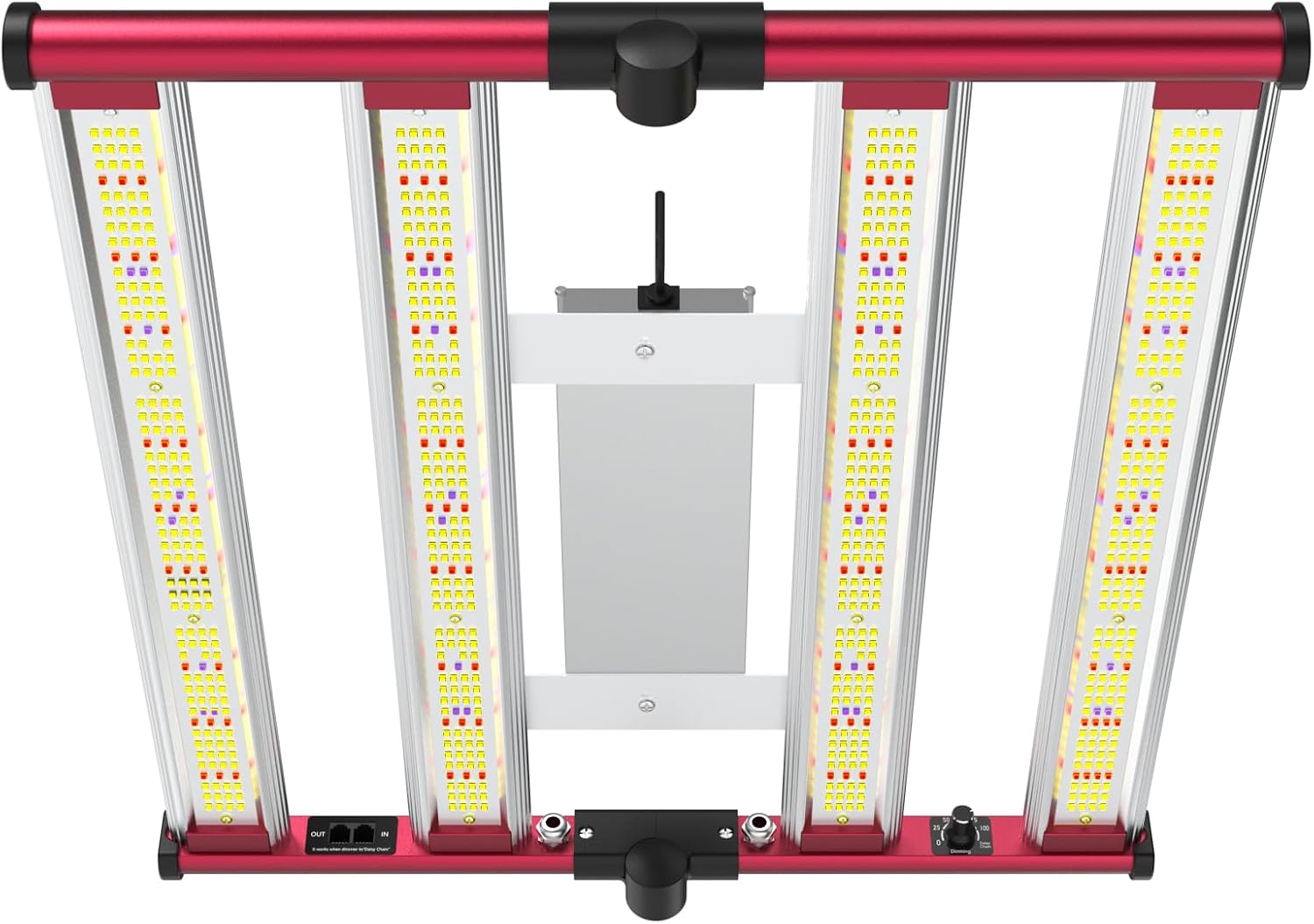
6. 240W LED Grow Lights – Fanless Quiet Operation
Fanless Quiet Operation
PROS
- ✓Fanless, so very quiet
- ✓Dimming from 0 to 100 percent
- ✓UV and IR included in spectrum
- ✓Daisy chain up to 100 lights
- ✓Works on 110 to 277 volts
CONS
- ✗No fan means heat relies on the aluminum body
- ✗UV output calls for eye protection
240W LED Grow Lights UV IR Grow…
- 240W full spectrum with UV and IR
- 0 to 100% dimming
- 1056 µmol/m²/s PPFD
- Aluminum heat dissipation
- Fits 3×3 and 4×4 tents
The 240W LED Grow Lights uses 780 SMD diodes across a full spectrum that adds UV at 405 nm and IR at 730 nm to the usual warm white, cool white, blue and red mix. The maker lists PPFD at 1056 µmol/m²/s and compares output to a 550W HPS while drawing 240W. For a square tent, that is a lot of diode count spread across the panel.
The fanless design is the detail owners tend to like. Heat moves into the aluminum body instead of a fan, so operation is quiet and there are no moving parts to fail. Dimming runs 0 to 100 percent, and the daisy chain supports up to 100 lights on one control, which is aimed at commercial rooms rather than a single tent.
It is rated for 110 to 277 volts, so it covers common household supply. We see it as a fit for growers who want a quiet, dimmable bar light over a square canopy and may expand later. The UV and IR diodes add spectrum but also mean you should plan eye protection when working under it.
Best for Quiet Grow Spaces
This suits growers who keep a tent in a living space or bedroom and want quiet operation. The fanless aluminum body removes fan noise entirely.
It also fits anyone planning to expand, since the daisy chain handles up to 100 lights and the voltage range covers 110 to 277. The added UV and IR broaden the spectrum.
Not Ideal for Fan-Cooled Preference
Skip it if you prefer active airflow across the fixture. There is no fan, so heat leaves through the aluminum body only.
It is also a weaker match for growers who want the simplest possible setup. Daisy chaining and UV precautions add a little planning.
7. LED Grow Light – Lens Focused Intensity
Lens Focused Intensity

PROS
- ✓Strong PPFD numbers for the wattage
- ✓Separate veg and bloom spectrum control
- ✓Lens design pushes light deeper
- ✓Daisy chain and controller ready
- ✓Passive aluminum cooling, no fan noise
CONS
- ✗Heavier intensity needs heat planning
- ✗Controller features add setup complexity
OptiGrowX240 LED Grow Light, Full Spectrum for…
- 220W replaces 400W HPS/HID
- 952 high output full spectrum LEDs
- Daisy chain up to 100 lights
- RJ45 port for external controllers
- Aluminum body with passive cooling
The LED Grow Light is the option we would point to when raw intensity matters most in a square footprint. Its optical lens directs light down into the canopy rather than scattering it, and the rated 1500+ PPFD at 16 inches plus 400+ PPFD at 36 inches gives you real reach for taller plants. Owners commonly note that lower leaves stay lit longer than with plain board designs.
Independent Veg and Bloom knobs let you shift the spectrum as the cycle moves, which suits a tent used for both vegetative growth and flowering without swapping fixtures. The 952 LEDs cover 3000K, 4000K, 5000K, 450nm, 660nm and 730nm, so the full spectrum claim holds up on paper. At 220W it is positioned as a replacement for 400W HPS setups, and the aluminum body runs passively with no fan.
For a 2×2 or 3×3 space, the square shape and even coverage are the practical draw. The RJ45 port supports daisy chaining up to 100 lights and connection to external controllers, which matters if you plan to expand later. The main tradeoff is that this is a fixture built around intensity and control, so you will want a tent that can handle the heat and a timer that suits the dimming setup.
Best for High Light Demands
This one suits growers running a square tent who want serious intensity without stepping up to a much larger fixture. The lens and high PPFD ratings make it a fit for flowering cycles where light penetration to lower buds matters.
It also works for anyone planning to scale. The daisy chain and RJ45 controller support mean a single light can grow into a multi-light setup without replacing the original unit.
Not Ideal for Low Ceilings
Skip it if your tent is short or your space runs warm, since the high output at close range demands headroom and airflow. A gentler fixture may be easier to manage in tight quarters.
It is also overkill for a small mother plant or clone tent. The spectrum knobs and controller port are wasted there, and a simpler dimmable unit would do the same job.
8. Spider Farmer SF1000 LED – Quiet Efficient Coverage
Quiet Efficient Coverage

PROS
- ✓Very efficient for 100W
- ✓Silent fanless operation
- ✓Even diode placement at edges
- ✓Five year after service support
- ✓Simple dimming knob
CONS
- ✗Low wattage for full 3×3 flowering
- ✗IR diode is dim and hard to see
Spider Farmer SF1000 LED Grow Lights for…
- 100W dimmable full spectrum LED
- 250 diodes with IR 760nm
- Fanless aluminum heat sink
- Compatible with GGS controllers
- Covers 2×2 and 3×3 tents
The Spider Farmer SF1000 LED is the compact, quiet pick for a smaller tent. At 100W with 250 diodes it will not flood a large canopy, but the 2.5 umol/J system efficiency and even diode layout mean the light it does produce spreads well. Owners frequently report it as a solid starter or veg light for a 2×2, and it can work in a 3×3 for early stages.
The spectrum runs white, blue, red and IR at 3000K, 5000K, 660nm and 760nm, with a blue lean that supports vegetative growth and root development. A single dimming knob adjusts intensity, and the unit is compatible with GGS controllers for scheduled control. The fanless aluminum heat sink keeps it silent, which matters in bedrooms and small apartments.
Build quality is where this one earns its place. Thick aluminum, protected cabling and a five year after service program through local maintenance centers give it a longer support window than most budget boards. The honest limit is output: in a full 3×3 flower cycle it will leave corners dimmer than a higher wattage bar light, so plan it for veg, mothers or smaller footprints.
Best for Small Quiet Setups
This suits growers in a 2×2 tent or anyone using a 3×3 mainly for veg and early growth. The low wattage keeps heat and power draw down, and the fanless design means no noise in living spaces.
It is also a good fit for beginners who want a reputable brand with real after service. The single dimming knob and controller compatibility keep operation simple while leaving room to automate later.
Not Ideal for Full Flowering
Skip it if you plan to flower a full 3×3 canopy. At 100W it will not push the intensity that dense flowering demands, and corners will lag behind the center.
It is also a poor match for high yield commercial style runs. The efficiency is good, but the total output is simply too low for large spaces.
9. VIVOSUN LumaLight 320W LED – Even Bar Coverage
Even Bar Coverage

PROS
- ✓Excellent uniformity across the canopy
- ✓Lens design improves penetration
- ✓IP65 sealed bars resist moisture
- ✓320W suits full 3×3 flowering
- ✓App control when paired with GrowHub
CONS
- ✗GrowHub sold separately for smart control
- ✗Rectangular bars need matching tent layout
VIVOSUN LumaLight 320W LED Grow Light, Full…
- 320W full spectrum bar light
- White, blue, red and far-red
- Four level dimming knob
- GrowHub app compatibility
- Up to 36,000 hour lifespan
The VIVOSUN LumaLight 320W LED is the coverage focused choice for a full 3×3 canopy. Its light bar matrix is rated at up to 0.89 uniformity, which means fewer hot spots and more consistent light from edge to edge. For a square tent where corner plants usually suffer, that even spread is the feature that matters most.
The Micro-Lens Optic System uses curved lenses to concentrate light, and the brand rates the boost at up to 20% PPFD. Combined with the bar layout, that pushes light deeper into the canopy instead of pooling at the top. The spectrum covers 3000K, 5000K, 660nm and 730nm, which supports growth from early stages through flowering.
Practical details are strong too. The sealed bars carry an IP65 rating, so dust, mist and cleaning spray are less of a worry, and integrated heat sink fins help manage heat. Dimming runs in four steps from 25% to 100%, and the GrowHub app compatibility allows scheduled and remote control if you add the hub. The main caveat is that smart control is an add on, not included.
Best for Even Canopy Spread
This is the pick for growers filling a 3×3 with multiple plants and wanting consistent light to the edges. The 0.89 uniformity and 320W output make it a genuine full cycle option for that footprint.
It also suits anyone who values easy cleaning and moisture resistance. The IP65 bars and sealed design hold up in humid tents and messy watering routines better than open boards.
Not Ideal for Budget Smart Control
Skip it if you expect app control out of the box. The GrowHub is sold separately, so the smart features cost extra on top of the light.
It is also less ideal for very small tents. At 320W and with a wide bar footprint, it is more light than a 2×2 needs and may be hard to position without waste.
10. 240W LED Grow Bar – Quiet Daisy-Chain Coverage
Quiet Daisy-Chain Coverage

PROS
- ✓Daisy-chain dimming across many lamps
- ✓Fanless design runs silent
- ✓IP65 waterproof beads handle splashes
- ✓Passive aluminium cooling
- ✓Fits a 3×3 tent footprint
CONS
- ✗No built-in timer or scheduling
- ✗Single light covers one 3×3 area only
240W LED Grow Lights 3×3 Growing Bar…
- 240 watts across a 23 inch frame
- Daisy-chain dimming for multiple lamps
- 0-10V control with daisy-chain support
- Fanless aluminium heat dissipation
- IP65 waterproof full spectrum beads
This 240W LED Grow Light fills a 3×3 space with a rectangular 23 by 23 inch frame that hangs flat over the canopy. Our research shows the full spectrum output and 240 watts suit both veg and flower stages, and the dimmer lets you dial intensity down for seedlings or clones. It is a sensible starting point for anyone setting up a small tent who wants coverage without overspending on power.
The daisy-chain function is the headline feature. You can link up to 100+ lamps and dim them together, and the master/slave modes mean one light controls the rest. For a 3×3 tent this matters if you later add a second tent or run a small grow room, because you set the first unit and the others follow. External 0-10V control is also supported for growers who use a controller.
Heat and moisture are the two risks in a small tent, and the aluminium bars handle both. The fanless design means no noise and no moving parts to fail, and the passive cooling removes the need for extra cooling gear. The IP65 rating and spray-glued beads mean splashes from watering are not a worry. At 4 kg it is light enough to hang from standard tent bars.
Best for Quiet Small Tent Setups
This light suits growers running a single 3×3 tent who want full spectrum coverage without fan noise. The passive aluminium cooling and IP65 beads make it a low maintenance choice for a bedroom or garage setup where sound and water splashes are concerns.
It also fits growers planning to expand. The daisy-chain and master/slave modes let you add lamps later and dim them together, so a small tent today can grow into a small room without replacing the light.
Not Ideal for Large Rooms
Skip this if you need to cover a space much larger than 3×3 with a single fixture. The 23 inch frame and 240 watts are sized for one small tent, and spreading it wider will leave edges underlit.
Growers who want built-in timers or app scheduling should look elsewhere, since dimming here is manual or through an external 0-10V controller. It is a straightforward light, not a smart one.
How to Choose the Best 3×3 Led Grow Light
Matching Light Output to a 3×3 Foot Print
A 3×3 foot footprint works out to nine square feet, and that number drives almost every choice you make. Growers commonly target somewhere between 30 and 50 watts of drawn power per square foot for flowering plants, which puts a realistic range of roughly 250 to 450 watts over the whole 3×3 area.
We compared the draw figures on the products in this guide against that range when deciding which lights belong here. A light that lists 200W may still cover a 3×3 space well in veg, but the same fixture often runs softer in bloom.
Coverage shape matters as much as raw wattage. Boards and panels tend to spread light evenly across a square, while bar style fixtures spread it along one axis and rely on the bars running parallel. In a 3×3 tent the square shape of a panel often lines up neatly with the walls, so edge plants get comparable light to the centre.
We looked at how each fixture’s dimensions sit against a 3×3 floor plan, because a light that is too narrow leaves dark corners.
Hanging height and dimming change the real number you get at the canopy. Many of these lights dim from 100 percent down to low levels, which lets you run a 320W fixture gently over seedlings and then open it up in flower. We noted dimming range in our research because a 3×3 grow cycles through several stages in the same space. A light with no dimmer forces you to raise it higher to soften output.
Lens, Diode and Material Technology
Most modern 3×3 lights use LED diodes, and the diode brand and bin tell you a lot about efficiency. Samsung LM301 series diodes appear on several fixtures in this guide, and they are commonly paired with deep red or far red diodes to round out the spectrum. We compared the diode counts and the mix of white and red chips across the products we researched.
A higher diode count spread over the same area usually means less heat per chip and longer life.
Lenses and reflectors shape how that light reaches the canopy. Some fixtures use a clear cover over the diodes, while others leave them open with a reflector hood. Sealed covers keep moisture and dust off the board, which helps in a humid tent. Open designs with angled reflectors can push light back down that would otherwise spill sideways.
Material choices affect heat and weight. Aluminium heat sinks and folded metal housings are common on the better 3×3 lights, and they pull heat away from the diodes without a fan. Fanless passive cooling suits a small tent because it adds no noise and no extra moving parts. We flagged fixtures with thicker heat sinks as better suited to long flower cycles at full power.
Ratings, Categories and What the Numbers Mean
Marketing numbers on grow lights fall into a few categories, and they are not interchangeable. The wattage printed on the box is often a “replaces” figure, while the actual draw from the wall is lower and is the number that matters for a 3×3 space. We compared stated draw against the per square foot target when shortlisting lights. A fixture labelled 2000 in a model name does not mean 2000 watts.
PPF and PPFD are the figures serious growers look for, though not every brand publishes them. PPF describes total light output and PPFD describes intensity at a point on the canopy. For a 3×3, a PPFD map showing even numbers across the whole square is more useful than one big centre reading. We looked for published footprint charts where they existed and treated missing data as a caution flag.
Efficiency ratings like umol per joule help you compare fixtures fairly. Higher efficiency means more of your electricity becomes plant usable light and less becomes heat. In a small 3×3 tent, heat builds quickly, so efficiency has a direct effect on how hard your extraction fan has to work. We weighed efficiency alongside price when forming our picks.
Frame and Shape: Bars, Boards and Panels
Bar style fixtures, such as the ECOHOM Bar 320W LED and the VIVOSUN LumaLight 320W LED, spread diodes across several long strips. That layout suits a 3×3 because the bars can run front to back and cover the square more evenly than a single central cluster. Bars also sit closer to the canopy without hot spots, which helps in a tent with limited headroom.
We compared bar spacing on the fixtures in this guide to see how well each fills a 3×3.
Board and panel designs, like the Spider Farmer SF1000 LED and the KingLED KP2000 200W Grow, concentrate diodes on one flat surface. They are simple to hang, easy to clean and usually lighter than bar rigs. A single board can leave the corners of a 3×3 dimmer than the middle, so growers often run two smaller boards or accept a slightly smaller effective footprint. We noted which panels are sized to cover a full 3×3 on their own.
Frame build affects how the light hangs and how stable it stays. Foldable frames and adjustable brackets let you change the spread and fit the fixture into a tent with a carbon filter or fan in the way. We looked at hanging hardware and frame width in our comparison, since a 3×3 tent has little spare room at the top. A rigid frame that matches the tent width keeps the light level and secure.
Fit, Heat and Compatibility with 3×3 Gear
Fitting a light into a 3×3 tent is a puzzle of height, width and airflow. The fixture needs to clear your extraction fan, filter and any circulation fans without blocking the canopy. We checked the listed dimensions of each light against typical 3×3 tent sizes when building this guide. A light that is slightly narrower than the tent leaves room for clip fans and ducting.
Heat is the main risk in a small space. Even efficient LEDs give off heat, and a 3×3 with the tent zipped can climb fast without good extraction. Passive cooled fixtures help, but you still need an inline fan sized to exchange the tent air regularly. We noted in our research that owners commonly report heat as the first thing they manage after adding a stronger light.
Compatibility with timers, controllers and daisy chain ports makes a 3×3 easier to run. Many of the lights here support daisy chaining, which lets you link two fixtures on one outlet and one timer. Some work with external controllers for sunrise and sunset ramping. We compared connection options because a 3×3 often ends up with two smaller lights rather than one large one.
Care, Lifespan and Owner Feedback
LED fixtures generally need little maintenance, but a few habits extend their life. Wiping dust off the diodes or cover every few weeks keeps output strong, and keeping the heat sink clear of clutter helps it shed heat. We read owner feedback on how easy each light is to clean and how accessible the diodes are. Sealed covers are simpler to wipe down than open boards with tight reflector gaps.
Lifespan claims on these lights usually run into tens of thousands of hours, and dimming extends that further. Running a 320W fixture at 70 percent instead of full power reduces heat and stress on the diodes. We treated published hour ratings as a guide rather than a guarantee, since real life depends on heat and airflow. Owners commonly report drivers as the part that fails first on cheaper lights.
Owner feedback across the products we researched often centres on even coverage, heat and noise. Fanless lights draw praise for silence in bedrooms and small rooms, while some owners note that very compact panels need two units for a true 3×3 flower. We used those recurring comments, alongside the product data, to decide which lights suit a 3×3 grow and which are better for veg or a smaller footprint.
Our Research Process
We built this shortlist by comparing the specifications that matter for a 3×3 tent and by reading what owners say after a few grows.
- Specs: We compared wattage, PPFD and coverage claims, spectrum, dimming, and driver placement across every model, including the Barrina GrowForce BG02 200W and the Spider Farmer SF1000 LED.
- Fit: A 3×3 space needs a fixture that spreads light evenly to the corners, so we checked footprint dimensions and hanging height guidance against the 36 by 36 inch area.
- Materials: We reviewed build details such as heat sink design, bar versus board layout, waterproofing, and the quality of the hanging hardware.
- Owner feedback: We looked for repeated complaints in reviews, like flickering drivers, noisy fans, weak corner intensity, and dimmers that fail early, and noted which models drew them most.
- Expert guidance: We followed published advice from horticultural lighting specialists and experienced indoor growers on light intensity, spectrum, and heat management for a 3×3 footprint.
From that research we picked the models that balance honest coverage, sensible heat output, and dependable owner reports.
FAQs on Best 3×3 Led Grow Light
How Many Watts Does a 3×3 Led Grow Light Need for a Full Grow?
For a 3×3 led grow light, most growers aim for roughly 30 to 40 watts of true draw per square foot. That works out to about 270 to 360 watts of actual power for the 9 square foot footprint. We looked at the driver ratings and true wattage figures in the product data rather than the marketing wattage numbers, because those inflated claims tell you very little about real light output.
Check the true power draw on the specification sheet before you buy. A light that claims 1000 watts but pulls 150 watts from the wall will not flower a 3×3 space well. Owners of undersized units often report airy buds and slow growth, so match the true wattage to the footprint and keep the light within the hanging height the maker recommends.
Will a 3×3 Led Grow Light Cover My Whole Tent Evenly?
A 3×3 led grow light is designed around a 3 by 3 foot flowering footprint, so coverage depends on the diode layout and the lens angle. Boards with diodes spread across the panel give more even coverage than lights with a tight cluster in the centre. We compared the recommended flowering area in the product data for each model we researched and flagged units that only reach 3×3 in veg.
In a 3×3 tent, the walls reflect light back, which helps the edges, but a light with a narrow beam still leaves corners dim. Look for a model that lists 3×3 as its flowering coverage, not just its vegetative coverage. Owner feedback often mentions that raising the light too high to spread the beam costs intensity in the centre, so keep the recommended hang height.
What Height Should I Hang a 3×3 Led Grow Light Above My Plants?
Hang height for a 3×3 led grow light depends on the stage of growth and the power of the unit. Seedlings and clones usually sit further from the panel, while plants in flower can move closer as long as the leaves stay flat and healthy. We checked the recommended hanging distances in the product data for the lights we researched and noted where makers give separate figures for veg and bloom.
A common problem in a 3×3 space is light burn, which shows as bleached or curled top leaves. Owners often report this after moving a strong light too close without dimming it. If your unit has a dimmer, turn it down rather than hanging the light higher, and measure the distance from the canopy top, not the pot.
Does a 3×3 Led Grow Light Need Extra Cooling or Ventilation?
LED lights run cooler than older lamp types, but a 3×3 led grow light still adds heat to a small tent. Passive heatsinks and quiet fans are common on boards in this size, and the product data usually lists the heat output or recommended airflow. We looked at how each light manages heat and whether owners report hot spots near the driver.
In a 3×3 tent, an exhaust fan and a small oscillating fan are usually enough to move air across the canopy and pull heat out. Keep the driver outside the tent if the design allows it, since drivers give off heat. Owners commonly report that good airflow also helps prevent mould on dense flowers, so do not skip the circulation fan.
How Do I Avoid Light Burn and Bleaching with a 3×3 Led Grow Light?
Light burn is one of the most common problems owners report with a 3×3 led grow light, especially when a powerful unit runs at full strength in a small space. The signs are bleached tips, curled edges and leaves that look stressed at the top of the canopy. We compared dimming options and recommended hang heights in the product data to see which lights give you room to adjust.
Start at a lower intensity and raise it gradually over a week or two. Watch the tallest tops, since they take the most light in a 3×3 tent. If you see bleaching, dim the light or lift it a few inches rather than cutting the schedule, and keep a small fan moving air over the canopy to reduce heat stress.
What Should I Check on a 3×3 Led Grow Light Before Buying on a Budget?
On a budget, the key checks for a 3×3 led grow light are true wattage, diode quality and warranty terms. We compared the product data for driver brands, diode types and coverage claims across the lights we researched. A cheaper unit can still flower a 3×3 space if its true draw is close to 300 watts and the coverage is honestly listed.
Watch for inflated wattage claims and vague footprint figures, which are common in low cost listings. Check that the light fits your tent frame and that the hanging hardware is included. Owners of budget units often mention driver failure as the main risk, so a clear warranty and a replaceable driver matter more than extra features you will not use.
Conclusion
Our research team compared output, coverage, heat and owner feedback across this category, and the Barrina GrowForce BG02 200W is our best overall pick. It balances strong output with even coverage for a full 3×3 space, and owners commonly report steady, reliable performance.
For tighter budgets, the Spider Farmer SF1000 LED suits smaller setups and beginners. The VIVOSUN LumaLight 320W LED fits growers who want more power and coverage from a bar style fixture.
Whichever you choose, match the light’s footprint and wattage to your space before buying. A fixture that fits your area well will always beat a more powerful one that does not.

