
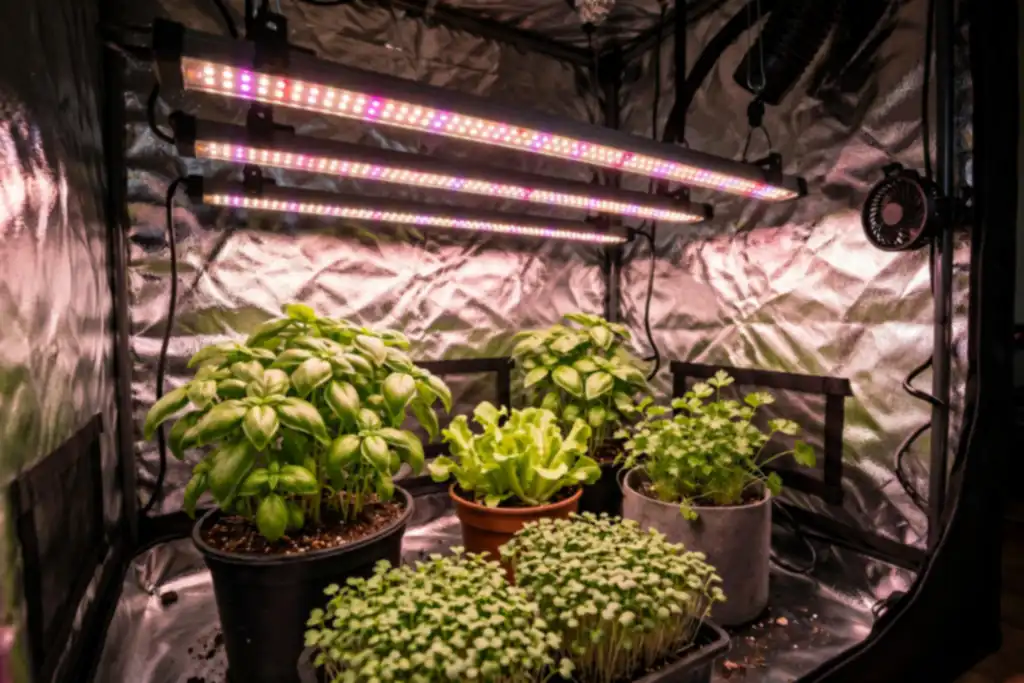
Your seedlings lean toward the window, stretching thin stems toward weak winter sun. A cheap blurple panel on the shelf below adds glare but little usable light. The plants tell you something is off before you check a single spec.
New growers and houseplant keepers often buy the first low cost panel they see, then deal with leggy starts, hot spots and fans that whine all night. Matching a light to your space and plants avoids that, which is why we compared the best affordable led grow lights.
We started with owner complaints in buyer reviews, from flickering drivers to misleading wattage claims. Below, you will find the best affordable led grow lights, each one suited to a different need.
Top 3 Picks for Best Affordable Led Grow Lights

Grow Light
- ▸148 premium LED chips
- ▸3 auto timer settings
- ▸Height range 10 to 25 inches

Grow Lights
- ▸Heights of 32, 47, 63 inches
- ▸Three lighting modes
- ▸Six dimming levels

Halo Plant Grow Light
- ▸48 LED beads total
- ▸Timer 4, 8, 12, 18 hours
- ▸Height 7 to 18 inches
10 Best Affordable Led Grow Lights
Affordable Led Grow Lights Reviewed
1. Grow Light – Foldable Full Spectrum
Foldable Full Spectrum
PROS
- ✓Full spectrum with red and blue chips
- ✓Three automatic timer settings
- ✓Two dimming levels
- ✓Adjustable height suits different plant sizes
- ✓Stable triangular base
CONS
- ✗Not waterproof, so keep it away from spray
- ✗Table mount limits placement to flat surfaces
Grow Light for Indoor Plant, 6000K Full…
- 148 chips: 120 white, 20 red, 8 blue
- 3 timer settings: 4, 8, 12 hours
- Dimmable at 50 percent or 100 percent
- Height adjustable from 10 to 25 inches
- Triangular iron base for stability
The Grow Light is the most flexible option in our affordable picks because it covers the full spectrum without asking much of a budget. Its 148 chips split into white, red and blue, so foliage, blooming and germination all get support from one lamp. The 6000K white output mimics daylight, which helps when plants sit far from a window.
Control is where this lamp earns its place. Three timer settings cycle the light on and off daily, and dimming at 50 or 100 percent lets you soften output for young seedlings. The stand adjusts from 10 to 25 inches, so the same unit can follow a plant from seed to a taller pot.
The triangular iron base keeps it steady on a desk or shelf without eating much surface. It is corded and rated at 120 volts, with a claimed 100 watt output and 20000 lumens maximum. For a cheap starter setup, the coverage and timer do most of the work.
Best for Desk and Shelf Growing
This suits anyone growing seedlings, succulents or potted plants on a desk, shelf or balcony. The timer and dimmer remove daily guesswork, which matters when you are home irregularly.
It also fits hobbyists who want one lamp to cover several small plants. The adjustable height and wide spectrum mean fewer purchases as plants grow.
Not Ideal for Wet Environments
Skip it if you mist plants heavily or grow in a humid tent. The lamp is not waterproof, so water contact is a real risk.
It is also a poor fit for large grow rooms. The table mount and modest footprint suit small collections, not rows of full sized plants.
2. Grow Lights – Tall Adjustable Stand
Tall Adjustable Stand
PROS
- ✓Tall stand reaches 63 inches
- ✓Rotating head for even coverage
- ✓Three spectrum modes
- ✓Six dimming levels
- ✓Long 13 foot power cord
CONS
- ✗Not waterproof
- ✗36 watts limits coverage for large plant counts
Grow Lights for Indoor Plants,Full Spectrum Plant…
- Detachable three section stand
- 360 degree rotating lamp head
- Three modes: warm white, red, full
- Six dimming levels from 10 to 100 percent
- 13 foot power cord
The Grow Lights is the floor standing pick, and its height range is the reason we included it. The detachable three section stand reaches 32, 47 or 63 inches, so one lamp can serve seedlings and then taller plants. A 360 degree rotating head spreads light more evenly across a group.
Spectrum control is broader than most budget lamps. You get warm white for germination, white and red for flowering, and full spectrum for general growth, all from 380 to 780 nm. Six dimming levels from 10 to 100 percent and a timer at 3, 9 or 12 hours cover most schedules.
The aluminum head helps with heat dissipation, and the heavy non slip base keeps the stand upright. A 13 foot cord gives real placement freedom in living rooms or offices. At 36 watts it is not a high output fixture, so think of it as steady coverage for a modest collection.
Best for Tall Indoor Plants
This fits growers with floor standing plants that outgrow desk lamps. The 63 inch maximum height lets light reach larger specimens without stacking boxes underneath.
It also suits people who want scheduled lighting while away. The timer and dimmer handle daily cycles, and the long cord makes placement easier.
Not Ideal for Dense Canopies
Skip it for a crowded tent or a big collection. At 36 watts, output is modest and better suited to a few plants than a full canopy.
It is also a poor choice where moisture is constant. The fixture is not waterproof, so humid rooms and heavy spraying are risky.
3. Halo Plant Grow Light – Compact Soil Stake
Compact Soil Stake
PROS
- ✓Very compact soil mounted design
- ✓Four timer options up to 18 hours
- ✓Five dimming levels
- ✓Rotatable head for angle control
- ✓Lightweight aluminum pole
CONS
- ✗10 watts suits only small plants
- ✗Not waterproof
Halo Plant Grow Light, 6000K White LED…
- 6 red, 6 blue, 36 white LEDs
- Five level dimming
- 180 degree rotatable head
- Pole pushes into soil
- Aluminum pole construction
The Halo Plant Grow Light is the smallest and simplest of the three, and that is its appeal. It uses 48 beads, split into 36 white, 6 red and 6 blue, to give a 6000K full spectrum aimed at potted plants and succulents. The pole pushes straight into the soil, so no stand or shelf space is needed.
The timer offers four options at 4, 8, 12 or 18 hours and repeats daily while plugged in. Five dimming levels let you dial output down for delicate seedlings. The aluminum pole extends from 7 to 18 inches and the head rotates 180 degrees for angle control.
At 10 watts it is a supplemental light, not a replacement for strong sun. Owners commonly use it on shelves, desks and tight corners where a full fixture will not fit. It is not waterproof, so drainage and spraying need care around the head.
Best for Single Small Plants
This suits one or two small plants that need a top up of light, such as succulents, herbs or bonsai on a desk. The stake design means no extra furniture.
It also works for people who want a long lighting window. The 18 hour timer option helps in dim corners where daylight is limited.
Not Ideal for Larger Collections
Skip it if you need to cover several plants at once. At 10 watts and a small head, the reach is limited to a single pot.
It is also wrong for wet routines. The fixture is not waterproof, so heavy misting or overhead watering can damage it.
4. Grow Lights Height – Height Adjustable Tripod
Height Adjustable Tripod

PROS
- ✓Wide height range suits small and large plants
- ✓Detachable tripod adds placement options
- ✓Timer repeats daily without manual switching
- ✓Aluminum build feels sturdier than plastic
- ✓Full spectrum covers veg and bloom stages
CONS
- ✗Single lamp covers a limited footprint
- ✗No dimming control for light intensity
Grow Lights for Indoor Plants Full Spectrum,16-63…
- Full spectrum 380nm to 800nm LEDs
- Aluminum alloy die-cast body
- 8/12/16 hour lighting modes
- Insert into pot or use tripod
- Table mount corded electric
The Grow Lights Height solves a common problem in budget setups. Most cheap lamps sit at one fixed distance, so you end up propping them on books or boxes as plants grow. This one extends from 16 to 63 inches, which covers seedlings on a desk and taller mature plants on the floor with the same unit.
The detachable tripod is the part we liked most in our research. You can push the pointed nut straight into a pot or stand it on the floor or desktop, so a single light adapts as your collection changes. The full spectrum range of 380nm to 800nm is aimed at blooms and fruiting, and the aluminum body should handle heat better than plastic housings at this price.
The timer is genuinely useful for people who forget. You set 8, 12 or 16 hours once and the light repeats the cycle daily without unplugging. For a low-cost lamp, the mix of height range, build material and automation is hard to argue with. Owners mostly mention the adjustability as the reason they picked it.
Best for Mixed Plant Sizes
This suits growers with a mix of seedlings and larger plants who want one lamp to serve both. The 16 to 63 inch range means you can raise it as plants stretch instead of buying a second light.
It also fits people who travel or work long hours. The memory timer keeps the cycle going, so a missed evening does not throw off the schedule.
Not Ideal for Dense Canopies
Skip this if you need to cover a wide shelf or a full tent. One lamp gives a focused spread, so a crowded canopy will leave edges underlit.
Growers who want to tune intensity for different stages should look elsewhere. There is no dimmer here, only the timer settings.
5. LED Grow Light Strip – Simple Stick-On Strip
Simple Stick-On Strip

PROS
- ✓Works with any USB power source
- ✓Tape and twist tie mounting is flexible
- ✓Flicker-free light with high color rendering
- ✓Very light and easy to reposition
- ✓12 month replacement warranty
CONS
- ✗USB adapter is not included
- ✗Not waterproof, keep away from water
LED Grow Light Strip for Indoor Plants…
- 84 LEDs at 6 watts
- Color rendering up to 90
- Flicker-free soft light output
- Twist ties for shelves and stands
- 30 day money back warranty
The LED Grow Light Strip is the simplest option in our lineup, and that is the point. It runs off any USB port with no adapter in the box, so most people can power it from a spare charger or power bank they already own. There are no modes to learn, just plug in and switch on.
Mounting is where this strip earns its place. Two double-sided tapes let you stick it to a clean solid surface, twist ties fasten it to plant stands and shelves, and your own screws work too. At 6 watts and 84 LEDs, it is a supplement rather than a main light, best used close to herbs, succulents or orchids on a desk or shelf.
The 5500K white and red mix mimics noon sunlight, and the color rendering of up to 90 keeps plants looking natural in a living space. It is not waterproof, so keep it away from misting and runoff. For a low-cost entry into plant lighting, the flexibility and the 12 month replacement warranty make it easy to recommend.
Best for Shelf and Desk Setups
This suits renters and small-space growers who cannot drill or hang fixtures. Tape and twist ties let you attach it to shelves, stands or cabinets and move it later without damage.
It also works for people supplementing low window light on herbs and succulents. The soft 5500K output is easy on the eyes in a living room.
Not Ideal for High Light Demand
Skip it if you are growing fruiting plants or dense canopies. At 6 watts it supplements light, it does not drive strong growth on its own.
Anyone without a spare USB charger should budget for one, since the adapter is not included. Humid setups are also a poor match given it is not waterproof.
6. 40W Full Spectrum Grow – Daisy Chain Panel Pack
Daisy Chain Panel Pack

PROS
- ✓Four panels cover a wide shelf area
- ✓Daisy chain runs from a single outlet
- ✓Timer with five settings and memory
- ✓Aluminum body handles heat well
- ✓Water resistant for humid areas
CONS
- ✗Not dimmable, output is fixed
- ✗Panels need mounting space on a shelf
40W Full Spectrum Grow Lights Panel for…
- 40W panel, 4000 lumens output
- 6000K, 3000K and 660nm mix
- Pure aluminum heat dissipation
- IP-rated water resistant design
- 365 day warranty included
The 40W Full Spectrum Grow is the pick for anyone lighting a shelf, cabinet or wall rather than a single pot. You get four thin panels covering 11.7 by 3.8 inches each, with 768 LEDs mixing 6000K white, 3000K warm white and 660nm red. That spread makes it far more practical for a row of seedlings than a single spotlight.
The daisy chain design is the feature we rate highest here. Industrial-grade waterproof connectors let you link panels from one outlet, which matters when a shelf has limited sockets. The timer offers 4, 8, 12, 16 or 20 hours and remembers the cycle, so it switches itself on and off daily. The aluminum body keeps heat down, so panels can sit close to foliage without scorching risk.
Water resistance adds peace of mind near misters and humid trays. Owners commonly mention the low running cost and the tidy install on plant shelves. It is not dimmable, so intensity is fixed, but for a budget multi-panel kit the coverage and automation are strong.
Best for Shelf and Cabinet Grows
This suits people starting seeds or herbs across a shelf or cabinet. Four panels give even coverage over a row of pots instead of a single hotspot.
It also fits setups with few outlets. Daisy chaining means one plug runs the whole set, and the memory timer handles the daily schedule.
Not Ideal for Single Pots
Skip this if you only grow one or two plants. Four panels are more coverage than a single pot needs, and the install takes more effort.
Growers who want to dial intensity down for seedlings should look for a dimmable fixture. This panel runs at a fixed 40 watts.
7. Grow Lights Yadoker – Telescopic Halo Stake
Telescopic Halo Stake

PROS
- ✓Full spectrum LED mix for all stages
- ✓Height adjusts with plant growth
- ✓Ten dimming levels for gentle output
- ✓Set and forget daily timer
- ✓Low voltage stays cool in long use
CONS
- ✗Not waterproof, so keep it away from spray
- ✗Stake mounting limits placement to pots
Grow Lights for Indoor Plants, yadoker Full…
- 72 LEDs, 380nm to 800nm spectrum
- Telescopic pole 13.7 to 61.1 inches
- 10 brightness levels, 10% to 100%
- 8, 12 or 16 hour auto timer
- 5V USB low voltage, UL listed
This halo light uses 72 LEDs split across white, warm white, red and blue, covering 380nm to 800nm for year round growth. The mix suits seedlings through to bloom without swapping anything. For a low cost setup, that full range is the main draw.
The telescopic pole runs from 13.7 to 61.1 inches, and the pointed stake pushes into soil, so the disc rises as the plant grows. Ten dimming steps from 10% to 100% let you soften the output for low light species. The inline controller handles dimming, timer and power in one place.
The 8, 12 and 16 hour timer repeats daily without replugging, and the long cord reaches dark corners. Running on 5V USB keeps it cool to the touch for long sessions, and it is UL listed and CE compliant. It is not waterproof, so keep water away from the head.
Best for Single Potted Plants
This suits growers with one or a few potted plants who want a simple light that rises as the plant grows. The stake pushes into soil and the pole extends, so no separate stand is needed.
The daily timer and dimming make it easy to run on a fixed schedule in a dark corner. Budget buyers get a full spectrum LED without paying for a floor stand.
Not Ideal for Watering Zones
Skip this if you mist plants heavily or water from above often. The unit is not waterproof, and the head sits close to the foliage.
Growers covering a wide bench of many plants should look elsewhere. The disc is sized for grouped pots, not a full shelf.
8. Plant Grow Lights – Tripod with Flex Necks
Tripod With Flex Necks

PROS
- ✓Four bendable heads reach separate plants
- ✓Tall tripod suits floor placement
- ✓Three spectral modes for growth stages
- ✓Timer runs daily without manual input
- ✓Independent control over the heads
CONS
- ✗Not waterproof for humid rooms
- ✗Floor footprint takes up space
Plant Grow Lights for Indoor Plants with…
- 80 LEDs, 50,000 hour lifetime
- Tripod stand 14 to 63 inches
- Four 360 degree flexible goosenecks
- 10 dimming levels, 3 spectral modes
- Cycle timer with memory function
This floor light carries 80 LEDs in a red, blue and warm yellow mix rated for 50,000 hours. The red band supports bloom and fruiting while the blue supports leaf growth. Three spectral modes let you switch the blend for different stages.
The tripod extends from 14 to 63 inches, and four 360 degree gooseneck heads bend toward individual plants. Ten dimming levels from 10% to 100% give fine control over intensity. The cycle timer remembers your setting and switches on and off daily on its own.
Dual controllers mean the heads can be managed independently, which helps when plants sit at different heights. The floor mount frees up shelf space, and the metal and aluminum base keeps it steady. It is not waterproof, so indoor placement away from moisture is the safe choice.
Best for Grouped Floor Plants
This fits growers with several plants at different heights, such as a corner of larger pots. The four goosenecks aim light where each plant needs it, and the tripod lifts the heads high.
The independent controllers and spectral modes give room to tune output per plant. It works well for someone who wants one light over a small floor collection.
Not Ideal for Tight Spaces
Skip this if floor space is limited. The tripod base needs room and is not a shelf or clamp design.
Growers in humid rooms should be careful. The unit is not waterproof, so misting and spills near the heads are a risk.
9. Full Spectrum Grow Lights – Detachable Aluminum Tripod
Detachable Aluminum Tripod

PROS
- ✓Three mounting options in one unit
- ✓Wide height range for all plant sizes
- ✓Full spectrum for flowers and fruit
- ✓Timer repeats daily with memory
- ✓Aluminum body looks neat indoors
CONS
- ✗Not suited to wet or humid spots
- ✗Three heads need aiming for even cover
Full Spectrum Grow Lights for Indoor Plants…
- Detachable tripod, stake or desktop use
- Height adjusts 15 to 62 inches
- Full spectrum 380nm to 800nm LEDs
- 8, 12 or 16 hour auto timer
- Aluminum alloy body, three heads
This three head lamp uses full spectrum LEDs from 380nm to 800nm to mimic natural sunlight. That range supports flowers, fruit and leafy growth across seasons. Three heads spread the light over a wider area than a single disc.
The detachable tripod is the flexible part. You can stake the pointed nut into a pot, stand it on the floor, or set it on a desktop. Height runs from 15 to 62 inches, so the same unit covers seedlings and taller mature plants.
The auto timer offers 8, 12 and 16 hour modes with cycle memory, switching on daily as set. The body is die cast aluminum from head to base, which keeps it light and tidy in a room. It is built for indoor table or floor mounting, not wet areas.
Best for Mixed Plant Sizes
This suits growers with a mix of small seedlings and taller plants. The height range and three heads cover different levels without buying separate lights.
The detachable tripod lets you move between pot, floor and desktop setups. It is a good pick for someone who rearranges plants often.
Not Ideal for Humid Rooms
Skip this for humid grow areas or rooms with heavy misting. The lamp is not built for wet conditions.
Growers wanting a single fixed spot may find the three heads need regular aiming to keep coverage even.
10. FECiDA Dimmable LED Grow – Quiet Dimmable Daisy Chain
Quiet Dimmable Daisy Chain

PROS
- ✓Real 130W draw keeps energy use low
- ✓Stepless dimmer covers all growth stages
- ✓Low-noise fan suits quiet home setups
- ✓Daisy chain expands without extra outlets
- ✓Aluminum heat sink rated over 50,000 hours
CONS
- ✗220 volt rating may not match every outlet
- ✗Small footprint limits it to compact tents
FECiDA Dimmable LED Grow Tent Light for…
- 130W real power, 1200W HPS equivalent
- Full spectrum 380-780 nm output
- Aluminum heat sink with low-noise fan
- Daisy chain port, no extra outlet
- Stepless dimming knob for all stages
The FECiDA Dimmable LED Grow is a compact rectangular fixture built around a 130W actual draw, which the maker compares to a 1200W HPS. We looked at the 3000K, 5000K and 660nm diode mix, and the full spectrum is aimed at seedlings through to flowering. For a small 2×2 ft tent, that power level keeps running costs modest while still giving decent intensity.
Cooling is handled by an aluminum heat sink with vents and a low-noise fan, which matters in a bedroom or closet grow where fan drone gets noticed. The stepless dimming knob lets you dial brightness down for seed starting and up for bloom without swapping gear. A daisy chain port links up to four of these units on one outlet, so a beginner can start small and scale later.
Owner feedback we reviewed often mentions the quiet operation and the simple dimmer as the practical wins. The 12000 lumen maximum output and 4000K color temperature suit leafy and flowering stages, though the 220 volt rating is worth checking against your wall supply before buying. For a first tent on a tight budget, the feature set is sensible rather than flashy.
Best for Small Quiet Tents
This light suits growers running a 2×2 ft tent in a bedroom, closet or spare room where noise is a real concern. The low-noise fan and aluminum heat sink keep things discreet, and the 130W draw is easy on the electricity bill.
Beginners who want to move from seedlings to flowering without buying new gear will appreciate the stepless dimmer. The daisy chain port also means a second or third unit can be added later on the same outlet.
Not Ideal for Large Rooms
Anyone lighting a 4×4 ft tent or a full room should skip this one. The 2×2 ft coverage and 130W output are too small to fill a larger canopy, and you would need several units to match.
Growers on 120 volt circuits should check compatibility first, since the 220 volt rating may require an adapter or a different supply. Commercial setups with high light demands will also want more power per fixture.
How to Choose the Best Affordable Led Grow Lights
What an Affordable LED Light Really Needs to Do
Budget LED lights are usually asked to do one or two jobs: start seeds and cuttings, keep houseplants alive through winter, or carry a small veg or herb garden. At this price point we look for honest power figures rather than big claims. A light that draws around 40W to 100W from the wall is typical for a small tent, a shelf or a single large plant, and that is enough for seedlings and leafy greens.
Fruiting plants and dense flowering need more light than most cheap panels can deliver, so we treat those as a stretch use rather than the main one.
Cheap lights fail in predictable ways. Output can fade over time, drivers can run hot, and quoted coverage is often larger than the usable footprint. We compared the wattage, spectrum and coverage claims in the product data against what owners commonly report, and the pattern is consistent. Lights that state their real wall draw and a realistic flowering footprint tend to satisfy buyers, while vague “replaces 1000W” claims usually disappoint.
Our shortlist for this guide includes options like the Grow Light, the FECiDA Dimmable LED Grow, the Halo Plant Grow Light and the LED Grow Light Strip. They sit in different shapes and power classes, which makes them useful for comparing how budget features are spread across the market. We picked them from product data and owner feedback, not from testing them ourselves.
LED Chips, Lenses and Spectrum: Reading the Labels
Most affordable lights use LED chips mounted on a board, sometimes behind a lens or a diffuser. A lens focuses light into a tighter beam, which suits a tall plant or a deep shelf, while a plain board spreads light wider for trays and shelves. Diffusers soften the light and reduce hot spots, which helps seedlings that scorch easily. None of these parts is automatically better. The right choice depends on the distance between the light and the canopy.
Spectrum labels describe the colour mix. Full spectrum means the light includes red and blue plus other wavelengths, so it looks white or pinkish and works for both leafy growth and flowering. Blurple panels, which look strongly purple, are common on cheap lights and are fine for veg, though many owners find white light easier to work under.
Red-heavy blends can help flowering, but at low wattage the effect is modest. We compared spectrum claims across the products we shortlisted and treated “full spectrum” as a starting point, not a guarantee of performance.
Watch for chip quality and heat. Better chips convert more electricity into light and less into heat, and a metal-backed board or a small fan helps move heat away. A cheap light that runs cool usually lasts longer than one that runs hot, because heat shortens LED life. We note this in our research because owner feedback about flickering and dimming often traces back to heat and driver quality.
Wattage, Coverage and Dimming: Matching the Light to the Space
Wattage is the number to check first, but it has to be the real draw from the wall, not an “equivalent” figure. For a seed tray or a shelf of herbs, roughly 40W to 60W is a sensible range. A small grow tent of about 60cm by 60cm usually wants something closer to 100W for veg, and more for flowering. If a listing quotes a huge equivalent number but a small actual draw, trust the actual draw.
Coverage follows from wattage and beam shape. A panel with a focused lens covers a smaller area well, while a bar or strip spreads light across a shelf. Manufacturers often quote coverage at a height where the light is too weak for flowering, so we compare the quoted footprint with the power class.
As a rule, a 40W to 60W light is best for a single plant or a small tray, and a 100W class light suits a compact tent. Buyers who match the light to the space report far fewer problems than those who stretch a small panel over a large area.
Dimming is a genuinely useful budget feature. Seedlings need less light than established plants, and a dimmer lets one light serve several stages. The FECiDA Dimmable LED Grow is an example of a budget option that includes this control. Without dimming, you raise and lower the light instead, which works but is less precise. We flagged dimming as a feature worth paying a little extra for.
Shapes and Frames: Bars, Panels, Strips and Halos
Shape decides where a light fits and how evenly it spreads. Panels are the classic budget format and suit a tent or a shelf with a flat top. Bars and strips spread light along a length, which works well for shelving units and long trays, and the LED Grow Light Strip is an example of that format.
Round halo designs, like the Halo Plant Grow Light, are aimed at single houseplants and small decorative setups. Each shape has a natural home, and choosing the wrong one is a common reason people end up disappointed.
Frame and mounting matter as much as the light itself. Cheap panels often ship with thin wire hangers or small clips, and heavier units need a proper hanging kit or a stand. Strips usually attach with adhesive or clips, which can fail on damp or dusty surfaces, so check the mounting method before buying. Halo lights often sit on a stake or a small base, which suits a pot on a table but not a grow tent.
Height adjustment is part of the frame story. A light that hangs from adjustable ropes or a ratchet hanger is easier to keep at the right distance as plants grow. The Grow Lights Height is a reminder that distance control is a real feature, not an afterthought. We looked for lights that can be raised and lowered easily, because fixed-height cheap lights force you to move the plants instead.
Fitting the Light into Your Existing Setup
Budget lights are rarely used alone. They sit alongside timers, small fans, tents, shelves and pots, and compatibility decides whether the setup works. Check the plug and cable length first, since a short cable limits where the light can hang. A mechanical timer is a cheap and reliable addition, and most budget lights work fine with one. Smart plugs also work, provided the light has a simple on and off switch rather than a touch control that resets.
Heat and humidity are the other fit issue. A cheap panel in a small, closed space can push temperatures up, so airflow matters. In a damp shelf setup, look for a light with a sealed or protected board, because moisture and cheap electronics do not mix. We compared how the shortlisted lights are built and mounted, and the ones with simpler, more protected housings tend to suit humid or dusty spots better. The Plant Grow Lights category covers many of these small-space options.
Think about the whole shelf or tent rather than one pot. A single 40W Full Spectrum Grow light can cover a small tray, but a full shelf needs either a longer strip or two smaller units. Matching the number of lights to the footprint is cheaper than buying one oversized panel that wastes light outside the canopy. We suggest planning the layout before buying, since returns on cheap lights are often more hassle than the saving.
Care, Lifespan and What Owners Report
Affordable LEDs need little maintenance, but a few habits extend their life. Keep the lens or board free of dust, since a dusty surface cuts output. Give the light space to breathe, and avoid enclosing a fan-cooled unit in a tight box. Check the hanging hardware now and then, because cheap clips and ropes are the parts that fail first.
None of this is difficult, and it is the main reason some budget lights last for years while others do not.
Lifespan claims on cheap lights should be read with care. LED chips degrade slowly, and output drops before a light fails completely. Owners commonly report that budget panels lose brightness over time, especially when run hot. A light with a dimmer and decent heat management is easier to keep useful as output falls, because you can raise it or run it longer.
We used owner feedback to weigh these points, since the product data alone rarely shows how a light holds up.
Warranty and support are worth a look before you buy. Budget lights often come with short warranties, and support can be slow, so a clear returns policy matters. We compared the terms listed for the shortlisted products and noted where support details were thin. The Grow Lights and Full Spectrum Grow Lights ranges include several options at this level, and the difference between them is often support and build rather than raw power.
Our picks for this guide lean toward lights with straightforward specs and fewer reported faults, based on the data and owner feedback we reviewed.
Our Research Process
We built this shortlist by comparing the product data, owner feedback and horticultural guidance that matter most for budget growing setups.
- Light output and spectrum: We compared wattage, spectrum coverage and dimming options across the listings, since a full spectrum and adjustable brightness are what most indoor growers look for at this price.
- Fit and coverage: We checked the dimensions and mounting options of each light, including strip and panel formats, to see which ones suit small tents, shelves and single plants.
- Build and safety: We looked at heat output, housing materials and any protection ratings listed in the product data, as cheap lights can cut corners here.
- Owner feedback: We read through common complaints in reviews, such as flickering, weak adhesive on strips or noisy fans, and noted which issues came up again and again.
- Expert guidance: We followed advice from indoor gardening specialists on matching light intensity to plant type and growth stage, so our picks reflect practical growing needs rather than headline wattage alone.
FAQs on Best Affordable Led Grow Lights
What Should We Look for in Affordable Led Grow Lights for a Small Indoor Setup?
We look at real draw power first, because budget panels often advertise big numbers that do not match what they pull from the wall. A light that lists its true wattage and its coverage area at a given hanging height tells you far more than a headline number. For a small tent or shelf, a compact panel with honest specs usually beats a cheap unit with inflated claims.
Spectrum matters too. Full spectrum white diodes with added red are common in affordable led grow lights and suit both veg and flower, while blurple panels can work but make it hard to judge plant health by eye. We also check whether the driver is built in or separate, since heat and replacement costs differ. Owner feedback often flags noisy fans and weak hanging hardware on the cheapest models.
Are Affordable Led Grow Lights Safe to Run Unattended at Home?
Safety comes down to build quality and how the light is installed. We compare listings for certified power supplies, grounded plugs and clear heat warnings, because the cheapest affordable led grow lights sometimes skip these details. A unit with a metal housing and proper ventilation runs cooler than a thin plastic panel crammed with diodes. Owners commonly report that cheap daisy chain connectors and loose drivers are the weak points.
Placement matters as much as the product. Keep the driver away from damp floors, use a timer rated for the load, and do not exceed the socket or circuit capacity. We suggest checking that the warranty covers the driver, since that part fails most often. If a light arrives with a damaged cord or a cracked housing, return it rather than repairing it yourself.
How Much Coverage Do Affordable Led Grow Lights Give at Different Hanging Heights?
Coverage shrinks fast as you raise the light, so the listed flowering footprint is the number to trust. Budget panels usually cover a small tent well at close range but spread thin light at the edges. We compare the recommended hanging distance for veg and flower, because affordable led grow lights often need to sit lower than premium fixtures to deliver useful intensity. That means less headroom for tall plants.
Sizing the light to the space avoids waste. A panel rated for a small footprint will underperform in a larger tent, and running two cheap units can cost more than one better matched fixture. Owners often report stretchy seedlings when the light sits too high. We suggest measuring your grow area first, then choosing a light whose stated footprint matches it with a little margin.
Why Do Cheap Led Grow Lights Burn or Bleach Leaves, and How Do We Avoid It?
Bleaching usually means too much intensity at the canopy, not a faulty light. Many affordable led grow lights concentrate diodes in the centre, so the middle of the plant gets far more light than the edges. Seedlings and young clones are especially easy to scorch. Owners commonly report pale, crispy tops after moving a new panel too close on day one.
We recommend starting high and watching the plants for a week before lowering the fixture. A simple light meter or a phone app gives a rough intensity reading and helps you set a consistent height. Raising the light, dimming it if the model allows, or spreading plants wider all reduce the risk. Rotating pots also evens out exposure under centre-heavy budget panels.
Do Affordable Led Grow Lights Cost More to Run Than They Save?
Running cost depends on true draw power and hours of use, not the purchase price. A low-wattage panel left on for long photoperiods can still add up, so we compare real wattage against the coverage it provides. Efficient affordable led grow lights deliver more usable light per watt, which matters over a full grow cycle. Cheap units that run hot waste power as heat.
We also factor in replacement risk. Budget fixtures with poor cooling may lose diodes or drivers sooner, and that hidden cost erodes the savings. Owners frequently mention fan noise and driver failure as reasons they replaced a cheap panel. Choosing a model with a modest warranty and honest wattage specs usually gives the better long term value for a small home grow.
How Do We Choose Affordable Led Grow Lights That Fit a Tent Without Hot Spots?
Fit is about matching the panel shape to the tent footprint and the hanging height you can spare. Square tents suit square panels, while narrow shelves suit bars or strips. We check the stated coverage at flowering distance, because affordable led grow lights often spread light unevenly at the corners. A slightly smaller footprint used at the right height beats an oversized panel crammed against the ceiling.
Hot spots come from clustered diodes and reflective walls bouncing light back. Keeping the light centred, using even hanging height and avoiding shiny surfaces near the canopy all help. Owners report better results when they rotate plants weekly and keep the fixture level. We suggest leaving a little clearance around the driver and checking that the hanging kit holds the panel flat.
Conclusion
Our research points to the Grow Light as the best overall choice for most setups. We compared product data, owner feedback and expert research across the range, and it offers the most balanced mix of spectrum coverage and value. For smaller spaces, the Halo Plant Grow Light suits growers who need a compact option, while the FECiDA Dimmable LED Grow fits anyone who wants simple brightness control.
Before buying, check the coverage area against your plant count and canopy size. A light that looks like good value can cost more in the long run if it cannot reach your whole growing space.

