
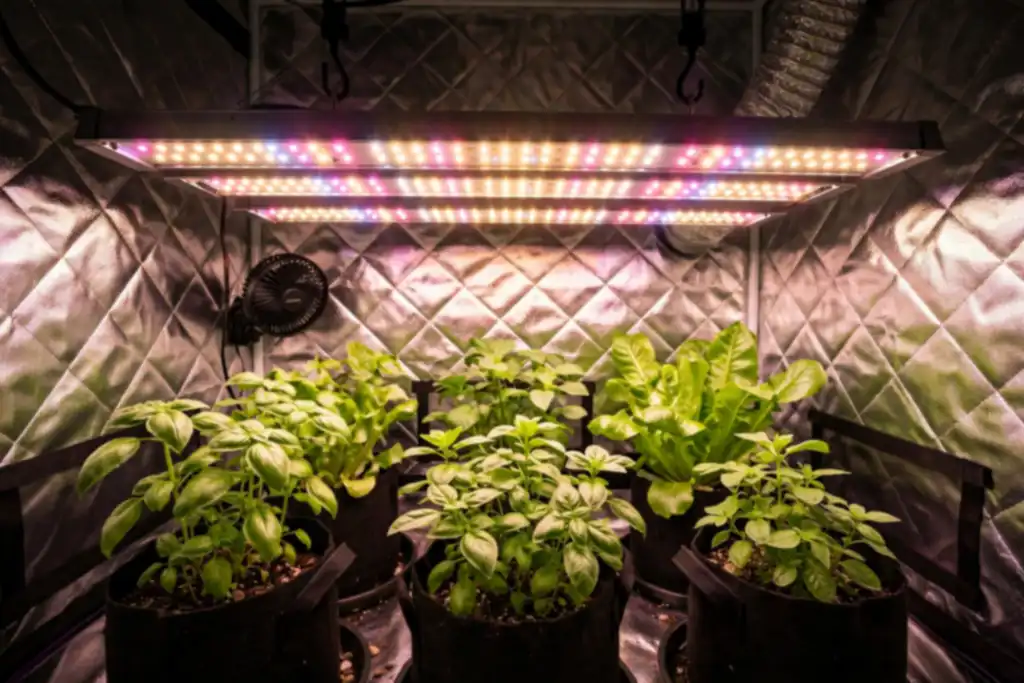
A full summer sky pours down light a plant can use, while a shaded windowsill leaves seedlings reaching for scraps. A best 400w LED grow light aims to close that gap indoors, delivering strong output without the heat of older lamps.
New growers and small-scale gardeners often buy on wattage alone, then end up with weak coverage or burnt leaves. Matching spectrum, dimming and footprint to your space matters more than the number on the box, which is why we point readers toward the best 400w led grow light for their setup.
We narrowed a long list down to a short set of picks, and every option had to pass one rule: honest, listed specs backed by owner feedback.
Top 3 Picks for Best 400w Led Grow Light

LED Grow Lights
- ▸LM281B+ and 660nm diodes
- ▸2.6-2.8 umol/J efficiency
- ▸Fanless zero-noise design

ECOHOM Bar 320W LED
- ▸2.8 umol/J efficacy rating
- ▸660nm and 730nm far-red
- ▸Detachable driver reduces heat

FECiDA Dimmable LED Grow
- ▸40000 lumen full spectrum
- ▸Stepless 0-100% dimming knob
- ▸UV-IR diodes included
10 Best 400w Led Grow Light
400w Led Grow Light: Our Top Picks Reviewed
1. LED Grow Lights – Quiet Full Spectrum Value
Quiet Full Spectrum Value
PROS
- ✓Strong PAR for a 3×3 area
- ✓Silent fanless operation
- ✓Daisy chain and dimming control
- ✓Efficient compared to HPS
- ✓5-year warranty coverage
CONS
- ✗No fan means tent airflow is essential
- ✗App control details are limited
LED Grow Lights for Indoor Plants, Full…
- LM281B+ LEDs plus EPI 660nm diodes
- 2.6-2.8 umol/J energy efficiency
- Covers a 3×3 grow area
- 0-100% dimming knob control
- Sunflower aluminum heatsink design
This RDJ Bouns fixture is the one we rank first for a 400W setup because the diode mix and efficiency figures line up well with what a 3×3 space needs. LM281B+ chips paired with EPI 660nm diodes give strong PAR output and better penetration into the canopy, and the 2.6-2.8 umol/J rating keeps running costs sensible next to old HPS gear.
Owners commonly mention the daisy chain ports and the 0-100% dimming knob as the features they actually use day to day.
Heat is the usual risk in a small tent, so the sunflower aluminum heatsink and three-proof coating matter here. The no-fan design runs silent, which suits bedrooms and living spaces, though it means airflow in the tent has to do the cooling work. The protection layer guards against dust, sulfide, water and oxidation, and the silicone-cured solder joints add a bit of confidence in humid rooms.
For seedlings through to flowering, the full spectrum covers every stage without swapping lights. The 5-year warranty and 24-hour support are the practical extras that make this a comfortable pick for a first serious grow. We would pair it with a small clip fan and a timer to get the most from the dimming range.
Best for Quiet Tent Grows
This suits growers running a 3×3 tent in a room where noise matters, such as a bedroom or shared living space. The fanless build and dimming knob keep it simple to live with.
It also fits anyone moving from HPS who wants lower running costs without losing output. The daisy chain ports make it easy to add a second unit later.
Not Ideal for Large Rooms
Skip it if you need to cover a space much bigger than 3×3, because a single unit will not spread far enough. You would need several linked together.
Growers who want heavy automation may find the control options basic. The dimming knob and push button cover the essentials but not much more.
2. ECOHOM Bar 320W LED – Bar Design Even Coverage
Bar Design Even Coverage
PROS
- ✓Even coverage with no hot spots
- ✓Far-red spectrum for flowering
- ✓Removable driver cuts tent heat
- ✓IP66 rating for humid rooms
- ✓Chains up to 50 units
CONS
- ✗Rated at 320W, not a full 400W
- ✗Higher price tier than basic boards
ECOHOM Bar 320W LED Grow Light, Full…
- 2.8 umol/J high efficacy
- 380nm to 780nm full spectrum
- Daisy chain up to 50 units
- IP66 waterproof rating
- 54,000+ hours lifespan
The ECOHOM Bar 320W LED takes second place because its bar layout solves the hot spot problem that plagues board lights in a 3×3 tent. Open bars spread light more evenly across the canopy, and the 2.8 umol/J efficacy figure is the highest in this group. The 380nm to 780nm spectrum includes 660nm deep red and 730nm far-red, which owners say helps flowering start faster.
The detachable driver is the detail we rate most for small grows. Moving it outside the tent drops ambient heat by 2-5°C, which matters when a 400W class light is pushing temperatures in a closed space. The IP66 rating and damp resistance suit humid rooms, and the retractable bars let you fit different tent widths.
Daisy chaining up to 50 units through one outlet with master dimming gives room to expand later. Passive cooling keeps it silent, and the 54,000+ hour lifespan with 95% output retention is a solid long-term figure. The 3-year support and U.S. based customer service round it out.
Best for Even Canopy Coverage
This is the pick for growers who want uniform light across a 3×3 canopy and care about flowering speed. The far-red diodes and bar spread make it a strong fit for photoperiod runs.
It also suits anyone fighting heat in a sealed tent, since the driver can live outside the grow space. Humid rooms and greenhouses benefit from the IP66 build.
Not Ideal for Tight Budgets
Skip it if you need maximum wattage on a strict budget, because it runs at 320W rather than a full 400W. The extra features come at a cost.
Growers with very small spaces may not need the retractable bar length. A compact board would be simpler and cheaper for a single small plant.
3. FECiDA Dimmable LED Grow – High Lumen Output
High Lumen Output
PROS
- ✓Very high 40000 lumen output
- ✓UV and IR diodes included
- ✓Stepless dimming saves power
- ✓Active fan cooling
- ✓Covers 2×4 or 3×3 tents
CONS
- ✗Fan adds some noise
- ✗Rectangular shape suits 2×4 better
FECiDA Dimmable LED Grow Tent Light for…
- 400W rated power output
- 40000 lumen brightness
- Fan cooled aluminum heatsink
- 3000K, 5000K, 660nm, UV-IR diodes
- Lifespan beyond 50,000 hours
The FECiDA Dimmable LED Grow comes third, but it is the brightest option on paper here with 40000 lumens from a 400W rated fixture. The 16.4 by 12.4 inch panel covers a 2×4 or 3×3 space, and the diode mix of 3000K, 5000K, 660nm plus UV and IR gives a broad sunlight-style spectrum. Owners report the stepless dimming knob is handy for stepping brightness down through veg and up through flower.
Unlike the fanless options, this one uses a low-noise fan and vented aluminum heatsink to keep temperatures down. That active cooling supports the 50,000+ hour lifespan claim, though it adds a small amount of running noise compared with passive designs. The dimming knob means you can save power in early stages instead of raising and lowering the light.
UV and IR diodes are the differentiator for growers chasing stronger growth and better flowering quality. The brand has been building grow lights since 2010, and the after-sales support is part of the pitch. For a 2×4 tent or a 3×3 with good height, it delivers serious output for the footprint.
Best for Bright 2×4 Tents
This fits growers with a 2×4 tent who want maximum brightness from a single panel. The rectangular shape and 40000 lumens suit a long, narrow canopy well.
It also appeals to anyone who wants UV and IR in the spectrum without adding separate bulbs. The dimming knob makes it easy to manage intensity across stages.
Not Ideal for Silent Setups
Skip it if noise is a dealbreaker, because the cooling fan is audible in a quiet room. Fanless lights are the better choice for bedrooms.
Growers with a square 4×4 space will find the rectangular panel leaves corners dimmer. A wider bar fixture would spread better.
4. VIVOSUN LumaLight 320W LED – Even Canopy Coverage
Even Canopy Coverage

PROS
- ✓Even light spread with low hot spots
- ✓Sealed IP65 bars handle mist and dust
- ✓Lens system concentrates light deeper
- ✓Four-step dimming covers each growth stage
- ✓Aluminum heatsinks help manage heat
CONS
- ✗Draws 320 watts, below the 400 watt class
- ✗App control needs the GrowHub sold separately
VIVOSUN LumaLight 320W LED Grow Light, Full…
- Up to 0.89 light uniformity
- Full spectrum white blue red far-red
- 4-level dimming knob 25% to 100%
- GrowHub app compatible, sold separately
- Aluminum body with heatsink fins
The VIVOSUN LumaLight 320W LED targets growers who want even light across a whole canopy rather than a bright center and weak edges. Its light-bar matrix is arranged to reach up to 0.89 uniformity, which helps limit hot spots over a full tent. The Micro-Lens Optic System uses curved lenses to concentrate light, and the brand claims up to 20 percent more PPFD. For a mid-power fixture, that spread matters more than raw output.
The spectrum mixes 3000K, 5000K, 660nm and 730nm diodes, so it covers vegetative growth through flowering. Sealed IP65 bars resist dust and mist, and the aluminum heatsink fins help move heat away from the diodes. VIVOSUN rates the lifespan at up to 36,000 hours. Dimming runs from 25 to 100 percent in four steps, and GrowHub compatibility adds app scheduling if you buy that controller separately.
In our research, owner feedback on this class of bar fixture tends to focus on coverage and heat control, and the sealed build suits humid rooms and regular cleaning. The 320 watt draw sits below the 400 watt mark, so it suits smaller tents or growers who prefer efficiency over maximum intensity. Check your canopy size before buying, because the even spread is the main reason to choose it.
Best for Even Tent Coverage
This fixture suits growers running a smaller tent who care more about even coverage than peak wattage. The bar layout and 0.89 uniformity keep edge plants closer to center plants in light received.
It also fits humid rooms and setups that get cleaned often, since the IP65 bars are sealed against dust and mist. Anyone who wants app scheduling should plan for the GrowHub add-on.
Not Ideal for Maximum Output
Growers chasing the full 400 watt class output should look elsewhere. At 320 watts, this light will not match higher-draw fixtures in a large canopy.
People who want built-in smart control may be disappointed too. The app features depend on a separate GrowHub purchase, so out of the box you get knob dimming only.
5. K4000 LED Grow Light – Daisy Chain Scaling
Daisy Chain Scaling

PROS
- ✓Daisy chain controls up to 100 units
- ✓Fanless design keeps the room quiet
- ✓Full spectrum includes UV and IR
- ✓Supports 110V and 277V wiring
- ✓Wide 5×5 to 5×6 foot coverage
CONS
- ✗Moderate intensity spread over a wide area
- ✗Fixed panel format limits tight-space mounting
K4000 LED Grow Light, Grow Light with…
- Full spectrum with UV and IR
- 0-100% dimming with daisy chain
- Comparable to 800W HPS/MH
- Covers 5×5 or 5×6 feet
- Runs on 110V or 277V
The K4000 LED Grow Light is built around scale. Its daisy chain feature lets users connect multiple fixtures, up to 100, and control them together, which suits commercial rooms and long rack runs. Dimming adjusts from 0 to 100 percent. The 1192 SMD LEDs produce a stated PPFD of 2343, and the brand compares the output to traditional 800W HPS or MH lamps while drawing 400 watts.
The spectrum includes 3000K, 5000K, 460nm blue, 660nm red, 730nm IR and 405nm UV, so it covers seedlings through flowering. Coverage is listed at 5×5 or 5×6 feet. Cooling is fanless, with aluminum pulling heat away, and the brand says the design limits light loss to aisles and walls. It runs on 110 or 277 volts, which helps in commercial wiring.
For our research, the daisy chain and voltage options are the practical reasons to pick this one. Owner feedback on fanless panels commonly mentions quieter rooms, and there are no moving parts to fail. The trade-off is that a 400 watt draw spread over five feet gives moderate intensity per square foot, so tall or demanding plants may want more fixtures. Plan your layout around the daisy chain limits.
Best for Multi-Light Rooms
This light suits commercial growers and rack setups that want many fixtures on one control chain. The 100-unit daisy chain and 110 or 277 volt options make wiring simpler in larger rooms.
It also works for quiet home grows, since the fanless aluminum body has no moving parts. Growers covering five foot spans with several fixtures will get the most from it.
Not Ideal for Small Tents
A single 400 watt panel over five feet is a lot of coverage for a small tent. Most small setups will not use the spread well, and the daisy chain advantage goes unused.
Growers with tall, light-hungry plants in a compact space should compare higher-intensity fixtures instead. This one favors width over concentrated punch.
6. Sun System P4000 HelioGrow – Controller Integration
Controller Integration

PROS
- ✓Memory restores brightness after outages
- ✓Works with standard RJ12 controllers
- ✓Daisy chain scales to 512 units
- ✓Corrosion-resistant lens protects diodes
- ✓Mounting hardware and 2-year warranty
CONS
- ✗Flowering footprint is only 3×3 feet
- ✗Plastic housing feels less rugged than metal
Sun System P4000 HelioGrow LED Grow Light…
- Corrosion-resistant lens cover
- Four push button brightness levels
- Memory restores settings after outages
- RJ12 controller compatible
- Mounting hardware included
The Sun System P4000 HelioGrow leans toward reliability and integration. It carries 1084 premium diodes under a corrosion-resistant lens cover that shields them from moisture and residue in busy grow rooms. A 2-year warranty backs the build. The full spectrum layout is described as sun-like and covers a 4×4 foot area in vegetative growth, dropping to 3×3 feet for flowering.
Control is handled by an integrated dimmer with four push button brightness levels. A memory function restores the last setting after a power disruption, so lights come back on schedule without manual resets. The fixture works with most standard RJ12 controllers for external brightness and timing, and it can daisy chain up to 512 units. Adjustable mounting hardware is included.
In our research, the memory function and RJ12 compatibility are the details that separate this from simpler panels. Owners of controller-driven rooms commonly value lights that resume settings after outages, and the sealed lens cover suits humid environments. The 3×3 foot flowering footprint is smaller than some rivals, so flowering rooms need more fixtures per area. The plastic housing is lighter than metal builds but less rugged.
Best for Controller-Driven Rooms
This fixture suits growers who already run RJ12 controllers and want lights that follow central timing and brightness commands. The 512-unit daisy chain supports large rooms.
It also helps anyone in areas with unstable power, since the memory function restores settings automatically. Humid rooms benefit from the sealed lens cover over the diodes.
Not Ideal for Tight Flowering Budgets
The 3×3 foot flowering footprint means more fixtures per square foot than wider lights. Growers filling a large flower room will spend more on units.
People who prefer metal housings may also skip it. The plastic body keeps weight down but offers less of the tank-like feel some commercial buyers expect.
7. SZHLUX 500W LED Grow – Timer and Temp Control
Timer and Temp Control

PROS
- ✓Automatic temperature based dimming
- ✓High diode count for even coverage
- ✓Fanless design runs quiet
- ✓Waterproof build
- ✓Timer built into the fixture
CONS
- ✗Heavy at 14.1 pounds
- ✗Ceiling mount limits placement options
SZHLUX 500W LED Grow Light 4×4/5x5ft with…
- 2.7 umol/J energy efficiency
- Timer and temperature control buttons
- Full spectrum with UV and IR
- Fanless aluminum heat dissipation
- Ceiling mount, 14.1 pounds
The SZHLUX 500W LED Grow is the pick for growers who want heat handled automatically. Its temperature sensor sets a protection point at 85F and steps the bars down as things warm up, which matters in a closed tent where a 400 watt class fixture can push temps quickly. We like that the timer and temp buttons sit on the unit itself, so you are not hunting for a separate controller.
Output comes from 1056 diodes at a rated 2.7 umol/J, with a full spectrum that includes 3000K, 5000K, 395nm UV and 760nm IR. That mix is aimed at keeping stems and leaves thick through veg while still carrying bloom. The fanless trapezoid aluminum body spreads heat over a larger area, and the waterproof rating gives some peace of mind in humid rooms.
It is a heavier unit at 14.1 pounds and mounts to the ceiling, so plan your hanging points before it arrives. The remote switch is handy for quick changes. For a 4×4 or 5×5 space where temperature swings are the real risk, this is a sensible fit.
Best for Heat Sensitive Tents
Growers running a sealed or low-airflow tent will get the most from the built-in temperature sensor. It protects the fixture and the plants without extra gear.
Anyone who wants timer and dimming control on the light itself, rather than a separate controller, will find this simple to live with.
Not Ideal for Low Ceilings
The 14.1 pound body and ceiling mount make it awkward in short rooms or spaces where you need to move the light often.
Growers who prefer a lightweight bar fixture they can reposition by hand should look at foldable options instead.
8. 600W LED Grow Lights – Foldable Daisy Chain Bars
Foldable Daisy Chain Bars

PROS
- ✓Even coverage from six bars
- ✓Wide 0 to 100 percent dimming
- ✓Daisy chain for multi light setups
- ✓Fanless and quiet
- ✓Folds for easy installation
CONS
- ✗120 volt only
- ✗No built-in timer
600W LED Grow Lights for Indoor Plants…
- 6 bar design, 33.5 inch length
- Dimmable 0 to 100 percent
- Daisy chain connection support
- Fanless aluminum heat dissipation
- Foldable plug and play setup
The 600W LED Grow Lights is built around six elongated bars that spread light across a 4×4 footprint more evenly than a single panel would. For a 400 watt style setup, that bar layout is the main draw, because even canopy coverage is what keeps lower buds developing. The 33.5 inch length suits most standard tents.
Dimming runs from 0 to 100 percent, so you can match intensity to seedlings, veg or flower without changing the hanging height every week. Daisy chaining lets you run several fixtures from one outlet, which is useful when you expand. The aluminum bars handle heat passively and there is no fan, so the room stays quiet.
Setup is the other strength. The foldable design means it is plug and play out of the box, and the light weight of the bars makes hanging simpler than a heavy panel. It runs on 120 volts. If you want flexible coverage and quiet operation, this is a strong fit.
Best for Even Canopy Coverage
Growers with a 4×4 tent who want light spread evenly across the canopy will appreciate the six bar layout and wide dimming range.
People running or planning multiple fixtures get real value from the daisy chain connection and the foldable, easy to hang design.
Not Ideal for Timer Dependent Setups
There is no built-in timer or scheduling here, so anyone who wants automated cycles will need a separate controller or timer.
Growers on higher voltage circuits should note it is rated for 120 volts only.
9. Lucius 400W LED Grow – Master Control Scheduling
Master Control Scheduling

PROS
- ✓Master control for multiple lights
- ✓Seven timer modes plus custom schedules
- ✓Settings survive power loss
- ✓Sunrise and sunset dimming
- ✓High 2.9 umol/J efficiency
CONS
- ✗Dimming limited to four levels
- ✗Higher cost than basic bar fixtures
Lucius 400W LED Grow Light with Master…
- Master control with LED display
- Timer modes including 18/6 and 12/12
- Power outage memory retention
- 972 LEDs, 2.9 umol/J efficiency
- Built in driver, passive cooling
The Lucius 400W LED Grow is the most control focused option of the three. Its master control design lets one light drive the rest, and the LED display makes schedules easy to set. For a 400 watt class fixture, that level of automation is unusual and it removes the need for a separate timer.
The timer has seven built in modes including 18/6, 12/12 and 20/4, plus custom 1 to 23 hour schedules that repeat daily. Settings survive a power outage, and the sunrise and sunset mode fades the light in and out instead of switching abruptly. Output comes from 972 LEDs at a rated 2.9 umol/J, with four level dimming from 25 to 100 percent.
The built-in driver keeps the body compact, and the four bars with 5mm heat sinks cool passively with low heat output. It hangs from above and covers a 32.67 by 17.99 inch area. For growers who want repeatable cycles and multi light control, this is the pick.
Best for Automated Grow Rooms
Growers running several lights who want one master unit to control them all will find the scheduling and display genuinely useful.
Anyone who values repeatable cycles, power outage memory and gentle sunrise transitions will get the most from this fixture.
Not Ideal for Simple Budget Setups
If you only run one light and set a basic timer, the master control and scheduling features add cost you may not need.
Growers who want fine grained dimming should note it offers four levels rather than a continuous range.
10. SZHLUX 400W LED Grow – Fanless Dual-Switch Control
Fanless Dual-Switch Control

PROS
- ✓Efficient 2.9 Umol/J output
- ✓Dual switches split 3 or 6 lights
- ✓Fanless design runs silent
- ✓Full spectrum includes IR
- ✓Waterproof and height adjustable
CONS
- ✗Only 4x4ft of coverage
- ✗Heat relies on room ventilation
SZHLUX 400W LED Grow Light 4×4ft Coverage…
- 864 LEDs over 4x4ft coverage
- Dual switches control 3 or 6 lights
- Full spectrum with IR 730nm
- Fanless aluminum shell and reflector
- 2.9 Umol/J at 400 watts
The SZHLUX 400W LED Grow is built around a simple idea. It spreads 864 LEDs across a 4x4ft footprint and draws 400 watts to do it. That works out to a claimed 2.9 Umol/J, which is efficient for a fixture in this class. For a 4×4 tent, the coverage figure is the number that matters most, and it lines up with the space.
The double switch setup is the practical detail we kept coming back to. You can run 3 or 6 lights independently, so seedlings and veg can sit under less intensity while bloom gets the full output. The trapezoid shape and SanAn 1W LEDs are meant to widen the luminous area compared with older T5 and T8 plant lights. A full spectrum of 3000K, 5000K, 660nm and IR 730nm covers both growth stages.
Heat is handled without fans. The aluminum shell and reflector move heat away, which keeps noise at zero and suits a quiet room or a bedroom setup. Owners commonly report that fanless designs like this run warm but stay manageable in a ventilated tent. At 10 pounds and roughly 24 inches square, it mounts easily and the adjustable height helps with canopy distance. The waterproof rating adds peace of mind in humid grow spaces.
Best for Quiet 4×4 Tents
This one suits a grower running a 4×4 tent who wants full spectrum light without fan noise. The dual switches let you step intensity down for seedlings and up for bloom without buying a second fixture.
It also fits anyone who values a simple, waterproof build in a humid space. The fanless aluminum body keeps the room quiet, which matters in living areas.
Not Ideal for Larger Rooms
Skip it if your canopy is bigger than 4x4ft. The coverage figure is fixed, and pushing it wider will leave edges dim.
It is also a poor fit for growers who want automated dimming. Control here is a touch switch, not a controller app.
How to Choose the Best 400w Led Grow Light
Why 400w Needs Its Own Buying Logic
A led grow light sits in a useful middle ground. It is strong enough for a serious hobby tent or a small flowering room, but it does not demand the electrical headroom of the 600w and 1000w fixtures. That middle position is exactly why the choice matters. You are buying enough power to make heat, light intensity and coverage decisions that actually affect the grow.
In our research we looked at what separates a good 400w fixture from a mediocre one. The answer is rarely the wattage number on the box. It is how the light spreads, how much of the wall draw becomes usable light, and whether the fixture fits the space and the gear you already own. We compared product data and owner feedback across the 400w category, including bar style lights, panel lights and dimmable models, to find the patterns that repeat.
Growers commonly report that a 400w light is the point where ventilation stops being optional. In a closed tent, the heat and humidity a 400w fixture generates need moving air. If you are upgrading from a smaller light, budget for extraction and circulation as part of the same purchase decision. The light is only half of the setup.
Light Quality and Diode Technology
Diode type and bin quality decide how efficiently a 400w fixture turns electricity into plant usable light. Modern fixtures use white full spectrum diodes, often mixed with red and far red diodes to support flowering. Older or budget designs may use blurple diodes with a narrow spectrum. Neither is automatically wrong, but full spectrum white is easier to work under and generally suits the whole grow cycle.
Lens and optic design matter as much as the diodes. Some 400w lights use a clear cover or a diffuser lens to spread light evenly and protect the diodes. Others leave the diodes exposed for maximum output. A lens can soften hot spots and improve uniformity, while exposed arrays may push more raw intensity straight down. We compared how each approach is described in product data and what owners say about even canopy coverage.
Efficiency is usually expressed as lumens per watt or as a stated efficacy figure. For a 400w class light, a higher efficacy number means more of that 400w reaches the canopy as light rather than heat. Look for the actual wall draw, not just the model name. A fixture sold as 400w should state its true power consumption, because some budget lights quote an equivalent wattage that does not match the real draw.
Real Wattage, Ratings and Safety Marks
The most common trap in this category is wattage inflation. Budget listings sometimes label a light 400w when the true draw is far lower. Before buying, check the stated power consumption and compare it with the model name. If a 400w light lists a draw well under 400w, treat the name as a marketing figure, not a specification.
Safety and electrical ratings deserve a close look. A 400w fixture pulls meaningful current, so check that the plug, cable and driver are rated for continuous use. Certifications such as ETL or UL listings, where stated, tell you the fixture has been assessed to a recognised standard. We looked for these marks in the product data because they are a better signal than a bold claim in the listing title.
Dimmability is another rating worth checking. A dimmable 400w light lets you run at lower output for seedlings and early veg, then ramp up for flowering. Models like the FECiDA Dimmable LED Grow show how this feature is presented. Confirm the dimming range and whether it is a knob, a remote or an app control, because the method affects how easy it is to use day to day.
Shape, Frame and Coverage Fit
Frame shape decides how the light fills your space. Bar style fixtures spread diodes across a long rectangle, which suits rectangular tents and helps even out intensity. Panel style fixtures concentrate the array in a square or compact rectangle, which can work well in square rooms. We compared bar and panel designs in the 400w class, including the ECOHOM Bar 320W LED and VIVOSUN LumaLight 320W LED as examples of the bar approach, to see how shape changes coverage.
Coverage claims should be read against your actual footprint. A 400w light is often marketed for a flowering area around 1.2 by 1.2 metres, with a larger footprint for veg. Those figures assume a certain hanging height and a reflective space. In a taller tent you can hang higher and spread the light wider. In a short tent the same fixture may need to sit closer, which concentrates intensity in the centre.
Physical size and hanging hardware matter more than buyers expect. Measure the inside of your tent or room before choosing. A long bar fixture can crowd a narrow space, while a heavy panel may need stronger support. Check the included hanging kit and the weight of the fixture. Owners often mention that a sturdy ratchet hanger set makes height adjustment much easier than basic wire hangers.
Compatibility with Your Existing Gear
A 400w light has to work with the rest of your setup, not against it. Ventilation is the first partner. The heat a 400w fixture adds to a tent changes the extraction you need, so match your fan and filter to the room volume and the light load. In our research, growers upgrading to 400w frequently report needing stronger airflow than their previous smaller light required.
Controllers and timers are the next compatibility point. Some fixtures run on simple analogue timers, while others pair with smart controllers or daisy chain dimming. If you already use a controller, check that the light supports the same protocol. Models such as the Sun System P4000 HelioGrow and the Lucius 400W LED Grow are worth checking against your existing control gear before you commit.
Reflective surfaces and tent quality also change how a 400w light performs. A well sealed tent with reflective walls makes better use of the output than an open room with dark surfaces. If you grow in an open space, plan for light spill and for the extra heat that escapes into the room. Matching the fixture to the enclosure is part of getting real value from the wattage.
Care, Lifespan and What Owners Report
LED fixtures need less maintenance than older lamp types, but they are not maintenance free. Dust on the diode cover or lens reduces output over time, so a soft wipe of the surface every few weeks helps. Keep the driver and any vents clear of obstruction. Good airflow around the fixture also helps the driver run cooler, which owners commonly link to longer service life.
Heat management is the main care topic in the 400w class. The fixture itself may run warm at the driver even when the diodes are cool. Mount the driver outside the tent where the design allows, and keep cables away from hot surfaces. If a light includes a dimmer or remote, store it somewhere dry and accessible rather than buried behind the canopy.
Owner feedback across the category tends to focus on three things: even coverage, real wattage and how quiet the setup stays. Lights that match their stated draw and spread evenly get consistent praise. Fixtures with vague power figures or narrow hotspots draw complaints. We used that pattern, alongside the product data, to shape the guidance above.
A 400w light chosen for honest specs, sensible shape and good compatibility will serve a small grow far better than a bigger number on the box.
Our Research Process
This shortlist comes from research into the key specifications for a led grow light, with those specifications compared across every option in this guide.
- Light output and efficiency: Stated wattage, spectrum coverage and dimmability were compared, allowing the picks to serve different growth stages instead of merely matching a number on the box.
- Fit and coverage: Recommended grow area, hanging height guidance and fixture dimensions were reviewed, including bar-style and panel-style designs suited to different tent sizes.
- Build and heat: Driver placement, passive versus active cooling and housing materials were examined, because heat management influences how close a light can sit to the canopy.
- Owner feedback: Common complaints in owner reviews were read through, such as noisy fans, flickering drivers and overstated coverage claims, and issues that came up repeatedly were noted.
- Expert guidance: Advice from horticultural lighting specialists was followed on matching wattage to grow space, reading spectrum charts and judging realistic coverage.
Our picks reflect that research and the product data available, not hands-on testing.
FAQs on Best 400w Led Grow Light
What Size Grow Space Does a 400w Led Grow Light Actually Cover?
A 400w led grow light is usually built for a flowering footprint of roughly 1.2 by 1.2 metres, with a slightly larger area for veg. We compared manufacturer footprint charts and owner reports, and most units in this class are listed at about 1.2m x 1.2m for bloom and up to 1.5m x 1.5m for vegetative growth. Anything bigger and the edges drop off fast, so plants at the corners stretch toward the centre.
Fit matters more than the wattage on the box. Measure your tent or room first, then check the recommended hanging height and coverage at that height. In a smaller space, such as 0.8m x 0.8m, a 400w led grow light gives strong intensity but needs dimming or extra height to avoid light burn.
Is a 400w Led Grow Light Safe to Run in a Small Tent?
Heat and electrical load are the two things we look at first. A 400w led grow light draws real power, so check that your circuit and timer can handle the load alongside fans and pumps. Owners commonly report that driver heat, not the diodes, is the main heat source, so mounting the driver outside the tent helps. Keep the light away from anything flammable and never drape fabric over the fixture.
Ventilation is part of safety, not an optional extra. A 400w led grow light in a small tent needs steady extraction to move hot air out and bring fresh air in. We also suggest checking the plug, cable and any daisy chain connections for damage before each run. If the fixture has a dimmer, use it during hot weather rather than pushing full power in a closed space.
How High Should I Hang a 400w Led Grow Light Above My Plants?
Hanging height depends on stage and on how the light spreads. For seedlings and clones, most 400w led grow light models are listed with a recommended distance that is much higher than flowering distance, often around 60 to 90cm, with the dimmer turned down. For veg, owners typically report lowering it and raising intensity. For flower, follow the manufacturer chart for your model.
Watch the plants rather than trusting a single number. Leaves that cup upward, bleach at the tips or look washed out suggest the 400w led grow light is too close or too bright. Stretching stems and wide node spacing suggest it is too far. We recommend adjusting in small steps and giving plants a few days to respond before moving again.
Why Does My 400w Led Grow Light Run Hot and How Do I Fix It?
A 400w led grow light converts most of its power to light, but the driver and heatsink still get warm, and in a closed tent that heat builds up. Owners often report the fixture itself is fine while the tent temperature climbs. The usual fix is stronger extraction, an oscillating fan moving air across the canopy, and pulling cooler air from outside the room.
Placement helps too. We suggest keeping the driver outside the grow area where the cable allows, and leaving space above the fixture for air to move. If your 400w led grow light has a dimmer, dropping to 80 percent during hot spells reduces heat without shutting down the grow. Check that intake vents are not blocked by pots or fabric.
What Should I Check Before Buying a 400w Led Grow Light on a Budget?
Cheap units often cut corners on the driver, the heatsink and the warranty, so we compare those three before anything else. A 400w led grow light at a low price may use a less efficient driver, which means more heat and less usable light per watt. Look for a clear footprint chart, a dimmer and a stated warranty period. Owner feedback on driver failures is worth reading closely.
Budget also means running costs and replacement parts. We check whether the fixture uses standard hanging hardware and whether the driver can be replaced separately. For a 400w led grow light, a slightly higher upfront price with a serviceable driver often works out cheaper than replacing a sealed unit. Avoid listings with no footprint data or vague power claims.
Can a 400w Led Grow Light Cause Light Burn or Bleaching?
Yes, and it is one of the most common problems owners report with this class of fixture. A 400w led grow light is strong for a small space, so running it at full power close to the canopy can bleach top leaves and slow growth. Symptoms include pale or white patches near the highest buds and leaves that curl away from the light.
The fix is distance, dimming and canopy management. We suggest raising the fixture, using the dimmer during the first week after switching to a 400w led grow light, and keeping the tallest tops level so no single cola sits right under the centre. If bleaching appears, move the light up and give the plant time to recover before changing anything else.
Conclusion
Based on a review of specifications, grower reports and specialist analysis, LED Grow Lights take the top spot for the majority of cultivators. They strike a rare balance among brightness, heat output and cost, and users frequently describe dependable outcomes through complete cycles.
The ECOHOM Bar 320W LED fits cultivators seeking uniform bar-style coverage inside a tent. The FECiDA Dimmable LED Grow is a practical option for newcomers who prefer straightforward dimming.
One final tip: pair the fixture with your room’s dimensions and confirm the actual draw wattage rather than trusting only the figure printed on the packaging.

